Stock Charts Setup For Beginners – How I Set Up My ASX Charts In TradingView Step By Step
When most beginners first open TradingView, they immediately become overwhelmed because there are hundreds of indicators, drawing tools, menus and chart settings all competing for attention. Many beginners assume a professional stock chart setup must look complicated, with multiple indicators stacked on top of each other and every possible tool turned on. The truth is usually the opposite. A clean chart helps you see price behaviour more clearly, while a cluttered chart can make even simple market structure feel confusing.
Stock Charts Setup For Beginners should begin with structure, clarity and consistency rather than complexity. The purpose of setting up a chart is not to make it look impressive. It is to create a workspace that allows you to see price clearly, follow the same process repeatedly and understand why each tool has been added.
One of the biggest mistakes beginners make is trying to shortcut the learning process by downloading indicators before they understand what price is actually doing. They copy chart layouts from social media, add somebody else’s indicators and change their screen every few days hoping confidence will appear. That creates noise instead of skill. TradingView becomes far more useful when it is treated as a structured learning environment rather than a prediction machine.
Where This Lesson Fits
Chart Setup → Practice → Risk → Complete Learning Framework
This page teaches one part of the beginner journey: creating a chart workspace that supports learning. You do not need to leave this page to chase other tools or resources while you work through it.
How To Set Up An ASX Share Chart In TradingView
This walkthrough helps you prepare a basic chart for learning. You will select an ASX share, choose how its price is displayed and save a layout you can return to. These instructions describe TradingView in a desktop browser; the arrangement can differ on a phone. Setting up the chart does not require you to place a trade or connect a broker account.
Open A Chart And Find Your ASX Share
Open TradingView and enter its Supercharts workspace. Select the symbol field near the top-left of the chart to open the symbol search. Type the company name or share code, then select the result showing the correct company and the ASX exchange. Check the company and exchange displayed on the chart before continuing, because similar names or codes can appear on different markets.
Choose A Candlestick Chart
Find the chart-type control in the upper toolbar and choose Candles. This displays price as individual candlesticks rather than a single line. Each candle represents the opening, highest, lowest and closing prices for its time period. For this exercise, use ordinary Candles so you are learning from that price information before exploring alternative chart types.
Select A Timeframe You Understand
Open the timeframe control in the upper toolbar and select one day, usually displayed as 1D or D. On this setting, each candle represents one trading day. Use the daily view for this learning exercise so you have a consistent starting point; it is not a recommendation for a particular trading strategy. Zoom out until you can see several months of price movement, while keeping the candles readable.
Remove Unwanted Indicators And Keep Price Readable
Look for the names of any indicators already displayed on the chart or in panels beneath it. Hover over an unwanted indicator’s name to reveal its controls, then use its remove or X control. Leave the main share price chart in place and remove only tools you do not need for this exercise. Begin with a clear view of price, because the sections below explain why supporting tools should be added with a purpose.
Save Your Beginner Chart Layout
Sign in to TradingView so you can save the layout to your account. Open the layout menu in the upper toolbar and give the layout a recognisable name, such as ASX Learning Chart. Use the Save control to store your changes. When you reopen the layout, check the share and timeframe again rather than assuming they are unchanged.
Your Setup Check
You Now Have A Chart Workspace For Learning
Check that the chart shows your intended ASX share. Confirm that you can identify the timeframe and see the price candles clearly. Make sure you recognise the layout name so you can return to it for practice. Next, read why price comes first and how supporting tools fit into the learning process.
Understanding Your Chart: Price Comes First
Before adding a single indicator to your chart, strip everything back and remove anything that does not need to be there. Delete old drawings, clear unnecessary indicators, remove clutter and zoom out so you can see the broader market structure properly. Most beginners spend too much time staring at small movements and not enough time understanding the bigger picture.
Price behaviour is the foundation because price is the information showing what buyers and sellers have actually done. Indicators are calculated from market information and should be used to support your understanding rather than replace it. That is why price should come first in a Stock Charts Setup For Beginners process.
The first questions should remain simple and structural. Is the ASX share trending higher, trending lower or moving sideways? Is price respecting previous highs and lows? Are buyers appearing stronger, or is momentum weakening? Can you identify obvious areas where price has reacted before? If you cannot yet make sense of the basic price structure, adding another indicator is unlikely to solve the problem.
TradingView works well at this stage because you can create one clean layout and save it for repeated use. Consistency matters. When the layout stays familiar, your attention can remain on what the market is doing rather than repeatedly learning a new screen.
Beginner Principle
Price First. Tools Second.
Indicators should help you interpret information you are already learning to see in the chart. They should not become a substitute for understanding price, trend, support, resistance and market structure.
Stock Charts Setup For Beginners – Step 2 – Add Supporting Tools Only When You Understand Their Purpose
Once the price structure begins to make sense, you can introduce a small number of supporting tools. For trading beginners, less is usually more. Too many indicators can create conflicting information and hesitation rather than clarity.
The objective is not to find a combination of indicators that predicts every market movement. The objective is to use carefully selected tools to support what price behaviour is already showing. A strong beginner chart setup should make structure easier to interpret, not cover it up.
- Moving Averages: can help visualise broader trend direction and alignment.
- RSI: can help a beginner observe momentum and whether price movement appears stretched.
- Volume: can provide additional information about participation behind price movement.
These 3 tools can provide useful supporting information without turning the screen into a wall of signals. Moving averages can help provide trend context, RSI can help you study momentum and volume can help you observe participation. None of them should make the trading decision for you.
This distinction is important in Stock Charts Setup For Beginners because beginners can easily confuse having more indicators with having more confirmation. More information is not always better information. Every tool needs a reason for being on the chart.
Practice The Setup Before Adding Real Financial Pressure
This is where paper trading becomes valuable. A beginner can practise reading chart structure, following a routine, placing simulated trades and reviewing decisions without immediately adding the emotional pressure of real capital. The purpose is not to prove that every paper trade can win. It is to practise following a process.
Paper trading also gives you time to become familiar with your TradingView workspace. Instead of learning chart analysis and platform navigation while money is at risk, you can build familiarity first. That separation makes the practice stage more useful and gives the beginner room to make mistakes, review them and repeat the process.
Confidence is not created by rushing into execution. It develops gradually when the same reasoning process can be practised and understood repeatedly.
Want To Understand Where Stock Charts Setup Fits Into The Complete Beginner Journey?
Chart setup is one part of learning trading properly. The Learn To Trade Roadmap shows what should come before it, what follows next and how the major beginner skills connect.
Continue To The Complete Learn To Trade RoadmapStock Charts Setup For Beginners – Step 3 – Advanced Chart Tools Can Wait
Once you understand market structure more clearly, tools such as Fibonacci and Elliott Wave can begin to have more context. Beginners often struggle with advanced technical tools because they are introduced before trend direction, support and resistance, timeframe context and basic price behaviour have become familiar.
Fibonacci can be used to study retracements and extensions within price movement, but it should not replace the structure already visible on the chart. Elliott Wave can provide another way of studying market progression and correction, but it can become confusing when a beginner tries to force a wave count onto price before understanding the broader market context.
The tools themselves are not necessarily the problem. The learning order is often the problem. When foundations are developed first, moving averages, RSI, volume, Fibonacci, Elliott Wave, support and resistance can be understood as different pieces of a wider analysis process rather than isolated answers.
Why The Learning Order Matters
Precision Does Not Replace Foundations
Advanced tools become more useful when the beginner already understands the structure they are being applied to. Learn what price is doing first. Add precision only when you understand why you need it.
Why TradingView Works Well For Trading Beginners
TradingView works well for beginners because it provides a professional charting environment without requiring you to use every feature at once. You can begin with one clean chart layout, save your settings, create watchlists, mark important areas and practise in a simulated environment while your understanding develops.
Consistency matters because beginners need repetition more than complexity. If your chart setup changes every few days, your visual process changes with it. When your layout remains familiar, your eyes gradually learn where to look and what information matters. That is part of how pattern recognition develops.
For ASX chart analysis, TradingView also allows beginners to zoom out, compare timeframes and observe longer-term price behaviour. The platform becomes most useful when it supports a structured learning process rather than being treated as a place to continually search for new trade ideas.
A clean Stock Charts Setup For Beginners process therefore uses TradingView with purpose. Start simple, build your understanding of structure, practise the same process and only add tools when you can explain why they belong on the screen.
A Simple TradingView Chart Setup Order
If you are setting up ASX stock charts in TradingView for the first time, the order matters. Begin by removing anything that distracts you from price. Zoom out enough to understand the larger market picture, then identify the most obvious structural information before adding supporting tools.
- Clear unnecessary drawings and indicators from the chart.
- Zoom out and identify the broader market structure.
- Observe obvious support and resistance areas.
- Add only the confirmation tools you understand.
- Use paper trading to practise the process before live execution.
- Save the layout so your TradingView workspace remains consistent.
This sequence helps prevent one of the most common beginner mistakes: building the chart around indicators instead of building it around understanding. Every tool on the screen should have a clear purpose. If you cannot explain why something is there, it may not need to be there yet.
The Goal
Build A Chart Process You Can Repeat
The best beginner chart setup is not the one with the most features. It is the one you can understand calmly, practise consistently and return to without rebuilding your process every time you open TradingView.
Stock Charts Setup For Beginners – Frequently Asked Questions
Is TradingView Good For Beginners Setting Up Stock Charts?
Yes. TradingView provides charting, watchlists, alerts, multiple timeframes and paper trading in one environment. A beginner can start with a simple layout and gradually introduce additional tools as their understanding develops. The key is not using every available feature. It is using the platform consistently and with a clear purpose.
Do I Need Paid Indicators To Begin Learning Trading?
No. Most beginners do not need paid indicators to begin learning chart analysis. Too many indicators can make a chart harder to interpret because they may provide conflicting information and create false confidence. A clean setup built around price, structure and a small number of understood tools is more useful than an overloaded chart.
Should Beginners Use Elliott Wave And Fibonacci Immediately?
Not necessarily. Elliott Wave and Fibonacci generally make more sense once the beginner understands broader market structure, trend direction, support and resistance and timeframe context. Introducing advanced tools too early can make technical analysis feel unnecessarily complicated. Foundations should come first.
Why Is Paper Trading Important After Setting Up My Charts?
A clean chart setup gives you a consistent environment, but practice is what helps you become familiar with the decision-making process. Paper trading allows you to practise reading the chart, following a routine and reviewing your decisions without immediately placing real money at risk.
Where Does Stock Chart Setup Fit Into Learning Trading?
Chart setup is one part of a much larger beginner learning process. Before live execution, a beginner also needs to understand market behaviour, chart reading, risk management, practice, psychology and how those skills connect. That is why She Trades Shares teaches chart setup as part of a structured journey rather than as an isolated technical exercise.
Where Should I Go Next After Learning The Basic Chart Setup?
The next logical step is to understand how chart setup fits into the complete beginner journey. The Learn To Trade Roadmap shows the learning sequence from understanding charts and market structure through practice, risk and the complete Trading For Beginners Framework.
You’ve Set Up The Learning Environment. Now See Where It Fits In The Journey.
The chart is only one part of learning trading. Continue to the Learn To Trade Roadmap and see what comes before chart analysis, what comes after it and how the complete beginner pathway fits together.
Continue To The Learn To Trade Beginner RoadmapEducational purposes only. This page provides general educational information and does not contain personal financial advice or a recommendation to buy or sell any financial product. Trading and investing involve risk, and individuals are responsible for their own financial decisions.
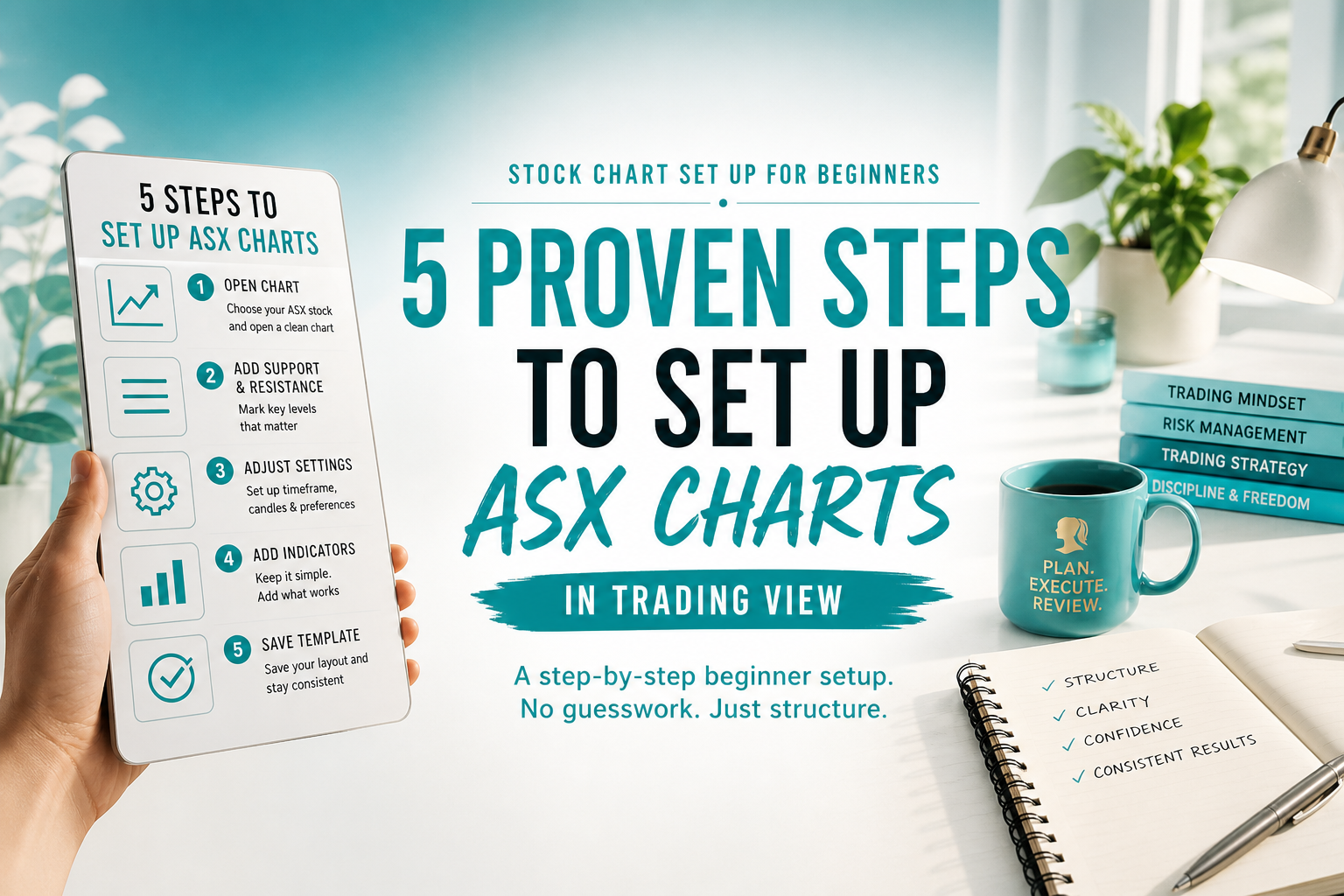
This is the correct way to set up your stock charts.