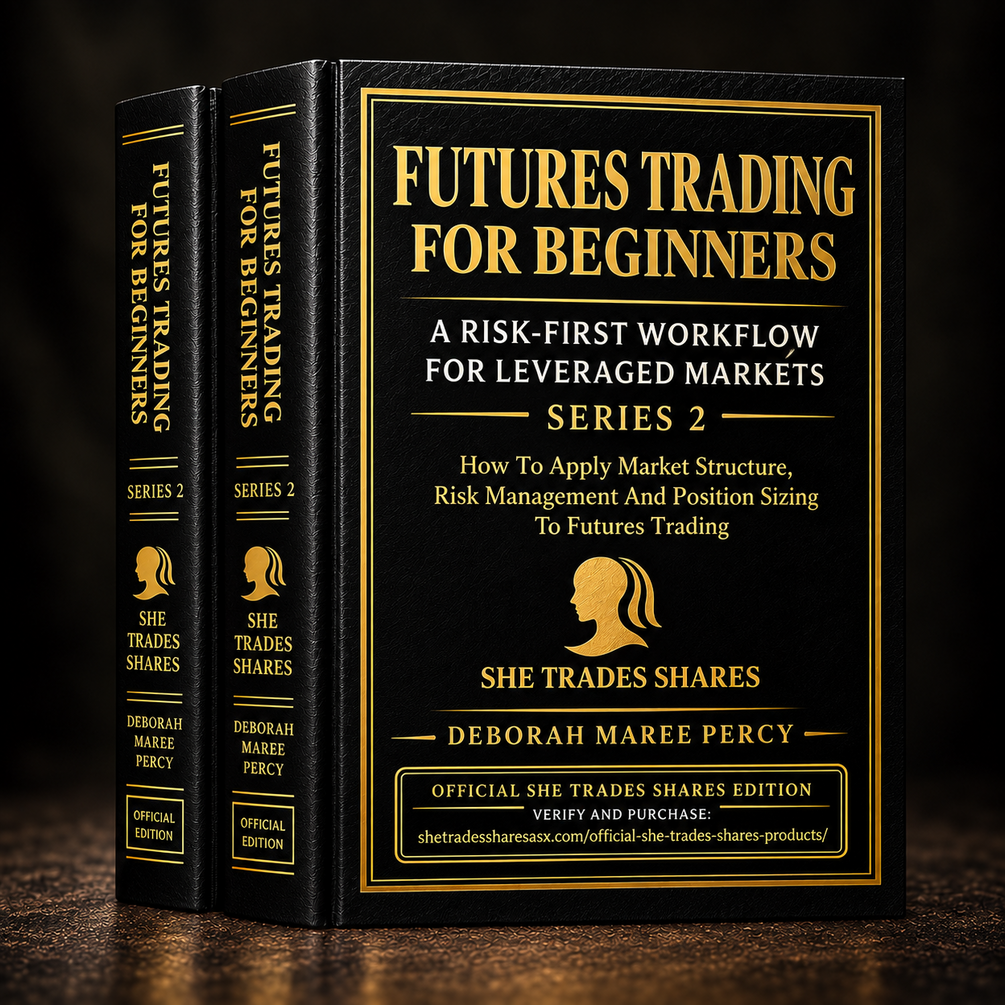
She Trades Shares — 2026 Edition — Series 2
Futures Trading For Beginners
A Risk-First Workflow For Leveraged Markets
Learn how to apply market structure, futures mechanics, exposure calculation, position sizing and disciplined risk management through a structured Futures Trading Course for traders who already understand the foundations.
The Futures Learning Order
Instrument → Exposure → Risk → Structure → Preparation → Execution → Discipline → Review
Futures Move Fast. Your Learning Process Should Not.
Understand the instrument and the financial exposure before execution becomes the focus.
Get The Structured Futures Trading For Beginners — $49Why Futures Trading Can Feel Chaotic
Futures are often introduced through speed: fast charts, leverage, entries, setups and funded-account challenges. But one futures contract can represent substantially more market exposure than the amount of capital required to support the position.
That means a trader can understand a chart yet still misunderstand what the position represents financially. A valid-looking setup does not answer questions about contract size, dollar movement, leverage or appropriate position size.
What Makes This Futures Trading Course Different?
The Structured Futures Trading deliberately reverses the common entry-first approach. Before execution, you learn what a futures contract represents, how tick and point values affect the account, how notional exposure is calculated, why margin and exposure are different and how leverage changes financial risk.
From there, Series 2 progresses through structure, contract selection, preparation, order mechanics, disciplined execution, capital protection, common traps, prop-firm rules, review and the complete futures blueprint.
The Learning Sequence
Contract Mechanics → Exposure → Leverage → Structure → Preparation → Execution
The objective is not to make futures appear easy. It is to give the trader a logical process for understanding what they are dealing with before speed takes over.
Why Exposure Comes Before Execution
One of the most important futures concepts is the difference between the margin required to support a position and the market exposure controlled by the contract.
A Simple Example Of Futures Exposure
Assume an index futures contract is trading at 8,800 points and has a $25 multiplier per point.
8,800 × $25 = $220,000 notional exposure.
Every 1-point move represents $25. A 10-point move represents $250. An 80-point move represents $2,000.
A 4% move from 8,800 equals 352 points. At $25 per point, that represents an $8,800 change in contract value. Whether that movement creates a gain or loss depends on the direction of the position.
The margin required to support the contract may be much smaller than $220,000. That is why margin should never be confused with exposure or treated as a maximum-loss amount.
Points
The chart shows movement in points.
Dollars
Your account experiences the financial value of that movement.
Margin
Supports the position but does not define the total exposure.
Understand The Exposure Before You Think About The Entry.
Start The Structured Futures Trading For Beginners — $49Who The Structured Futures Trading For Beginners Is For
Series 2 is designed for traders who already understand foundational chart structure and now want to apply that knowledge in a leveraged futures environment.
This Course May Suit You If…
- You understand market structure and swing behaviour.
- You understand basic top-down analysis.
- You want futures mechanics explained before setups.
- You want risk and position sizing considered before execution.
- You are willing to practise before deploying live capital.
- You value process, discipline and review over excitement.
This Course Is Not Designed For…
- Complete beginners who cannot yet read market structure.
- Anyone seeking trading signals or copy trading.
- Anyone looking for guaranteed income or profit.
- Anyone expecting a prediction system.
- Anyone unwilling to define and control risk.
- Anyone treating leverage or funded accounts as a shortcut around learning.
Do You Already Understand Market Structure?
This is the one question to answer before buying Series 2.
If trends, highs and lows, swing behaviour, top-down timeframe analysis and basic risk management are not yet familiar, build that foundation first. My Structured Futures Trading builds on those skills rather than teaching them from the beginning.
I Need The Foundation First — Show Me Trading For Beginners Series 1What You Get Inside Series 2
The course contains 15 progressive stages moving from futures mechanics and mathematics through structure, preparation, execution, capital protection, review and the final complete futures blueprint.
Structured Stages
One connected learning sequence from instrument mechanics to complete workflow.
Before Execution
Exposure, leverage and position size are treated as core knowledge.
Practical Examples
ES provides a consistent teaching anchor for contract mathematics and mechanics.
Cheat Sheets
Quick-reference reinforcement supports the major stages without replacing the lessons.
Final page count: 1183
By The End Of The Course, You Should Understand How To…
The aim is not to promise trading success. It is to build a clearer understanding of the mechanics, risk and process involved in futures.
- Explain what a futures contract represents.
- Calculate notional exposure.
- Understand tick size, tick value and point value.
- Explain the difference between margin and market exposure.
- Recognise how leverage changes financial risk.
- Identify the correct futures contract or series.
- Prepare a futures market before analysis.
- Understand basic futures order mechanics.
- Apply position sizing more deliberately.
- Follow a structured risk and review process.
- Understand how prop-firm rules change the trading environment.
- Bring the major stages together into one repeatable futures process.
The Intended Learning Outcome
Futures No Longer Feel Like A Collection Of Unconnected Moving Parts.
You understand what the instrument represents, why the risk behaves differently and how the major decisions fit inside one structured workflow.
Inside The 15-Stage Futures Trading Course
Each stage has a specific purpose. You begin with the instrument and progressively move towards disciplined execution and the complete workflow.
Stage 1 – Understanding The Futures Instrument
Learn futures terminology, contract multipliers, tick size, tick value, notional exposure, margin and leverage so you understand what the instrument represents.
Stage 2 – Platform Structure And Contract Identification
Understand charting versus broker platforms, ES contract identification, continuous versus expiry contracts, rollover and key instrument-level differences.
Stage 3 – Futures Mathematics Using Real ES Numbers
Work through ES contract calculations, point and dollar movement, percentage movement, contract scaling and Micro versus standard contracts.
Stage 4 – How Futures Actually Behave
Understand why futures can feel faster, how real-time P&L behaves and what leverage means when price moves against the position.
Stage 5 – Structure Comes First
Apply monthly structure, weekly confirmation and daily timing while keeping higher-timeframe context ahead of speed.
Stage 6 – Futures Market Selection And Preparation
Learn market categories, symbols, contract selection, watchlists and how to prepare the correct futures market before analysis.
Stage 7 – Order Execution Mechanics
Understand the broker order ticket, market, limit and stop orders, position entry, scaling, P&L and margin-call mechanics.
Stage 8 – Disciplined Futures Execution
Learn planning before clicking, stop-placement logic, following the trading plan and managing the position according to a defined process.
Stage 9 – Risk And Capital Protection
Study conservative position sizing, the 1-trade risk rule, exposure limits, drawdown control and when stepping away is the appropriate decision.
Stage 10 – Common Futures Traps
Recognise over-leveraging, premature lower-timeframe trading, ignored structure, emotional stop movement and revenge trading.
Stage 11 – Futures Compared To Other Markets
Compare futures with stocks, ETFs and CFDs and understand which structural principles remain universal across different instruments.
Stage 12 – Understanding Prop Firms And Funded Accounts
Understand evaluations, drawdown and daily-loss rules, challenge conditions, common failures and whether the prop-firm environment may suit you.
Stage 13 – Building A Conservative Futures Routine
Build weekly planning, daily check-ins, trade reviews, journalling and performance tracking into a repeatable routine.
Stage 14 – Futures Risk Matrix
Assess risk awareness, capital suitability, emotional suitability, when futures may not be appropriate and personal accountability.
Stage 15 – Complete Futures Blueprint
Bring instrument knowledge, exposure, structure, preparation, risk, execution and review together into one complete repeatable futures workflow.
15 Stages. One Connected Futures Workflow.
Get The Structured Futures Trading For Beginners Course $49What You Are Actually Paying For
Futures information already exists online. You can watch videos, read contract specifications, ask AI questions, research prop firms and open futures charts without buying this course.
The value of My Structured Futures Trading is not that the information cannot be found elsewhere.
The Value Is The Learning Sequence.
The 15 stages organise the information so you understand the instrument before leverage, exposure before execution, structure before speed, risk before position size creates unnecessary exposure, and review before poor habits become normal.
One Learning Order
Know what to study next instead of piecing futures education together yourself.
Risk-First Structure
Understand exposure and capital protection before execution becomes the focus.
Practical Mathematics
Connect points, ticks, contracts and movement to their financial consequences.
Complete Blueprint
Bring the individual lessons into one repeatable process.
Learn Futures Through A Complete Risk-First Learning Sequence.
Get The Structured Futures Trading For Beginners — $49Why I Created The Structured Futures Trading For Beginners Course
I created Series 2 after more people inside the She Trades Shares community began asking about futures. They were seeing leverage, contracts and funded accounts discussed regularly and wanted to understand what they were actually looking at.
My own market experience also taught me that chart knowledge alone is not enough. Position size, discipline, urgency and the ability to follow a defined process matter enormously when financial exposure increases.
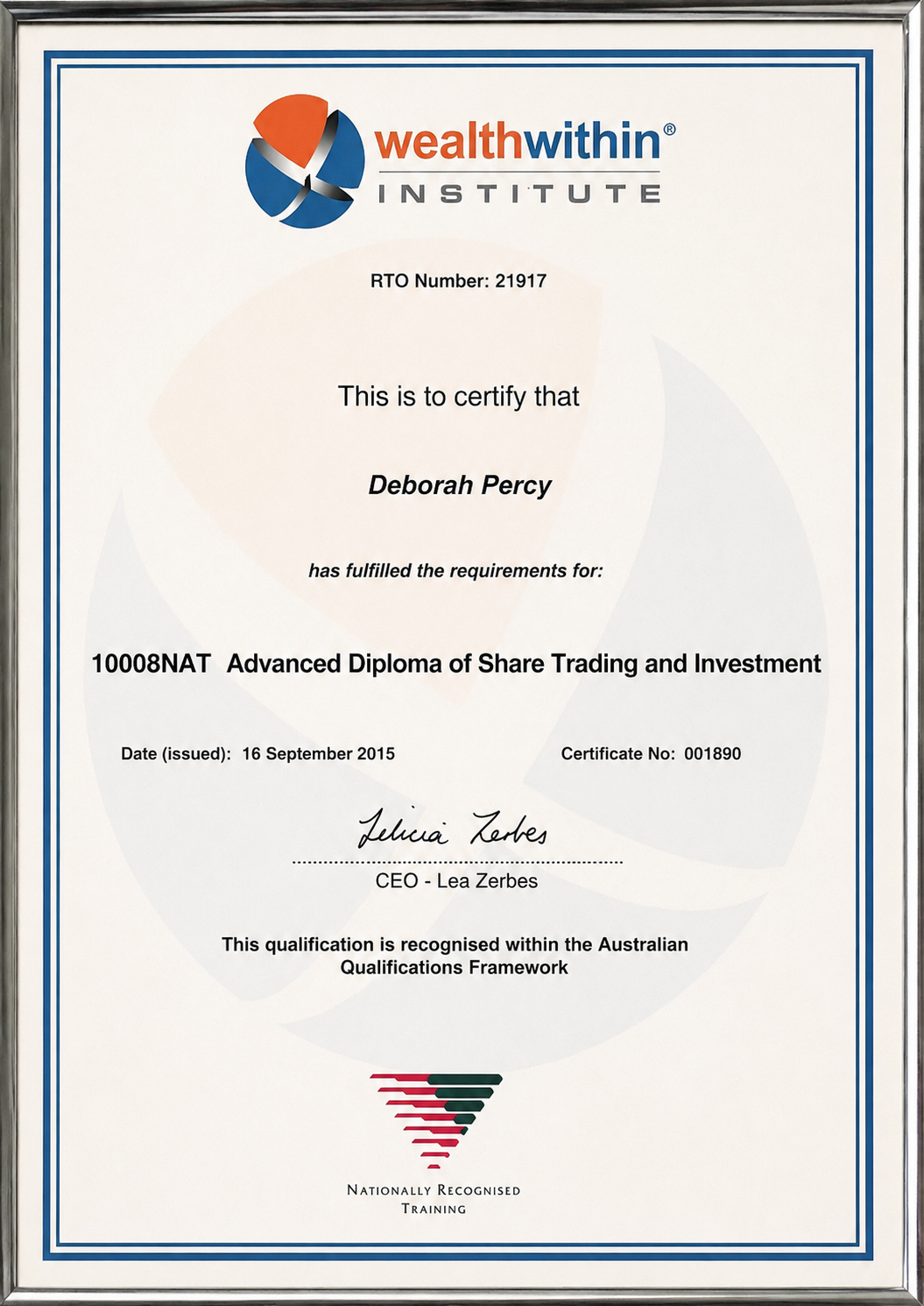
Advanced Diploma Of Share Trading And Investment
Deborah Maree Percy holds an Advanced Diploma of Share Trading and Investment, issued in 2015.
This qualification forms part of the educational background behind She Trades Shares. The course remains educational and does not provide personal financial advice.
Structure First. Risk First. Execution Second. Ego Nowhere.
How To Use Series 2
The course is designed to be worked through in order because later stages rely on knowledge developed earlier.
- Begin with the futures instrument and contract mechanics.
- Understand exposure, margin and leverage before execution.
- Keep higher-timeframe structure visible.
- Practise slowly before using live capital.
- Use cheat sheets as reinforcement, not replacements for the lessons.
- Review the process rather than chasing activity.
The Learning Principle
Repetition Builds Clarity → Clarity Builds Control → Control Supports Longevity
Futures Trading For Beginners Course — Frequently Asked Questions
Is This Suitable For A Complete Beginner?
Not as a first trading course. Series 2 assumes you already understand market structure, swing behaviour, top-down analysis and basic risk management. If those foundations are missing, complete Series 1 or equivalent foundational study first.
Does The Course Give Trading Signals?
No. It is an educational program, not a signal, copy-trading or prediction service. The objective is to help you understand futures and build your own structured process.
Does It Cover Position Sizing And Risk Management?
Yes. Position sizing, leverage, exposure, account risk, drawdown control and capital protection are major parts of the curriculum.
Does It Cover ES And Micro Futures?
Yes. ES is used as a primary teaching anchor, and the course also explains Micro versus standard contracts so the differences in contract size and financial movement are clear.
Does It Cover Prop Firms?
Yes. Stage 12 explains evaluations, drawdown rules, daily-loss limits, common challenge failures and suitability. The course does not guarantee funded-account approval or retention.
Does The Course Teach TradingView?
TradingView charts are used for contract identification, structure analysis and workflow examples. Available platform features and futures market-data access can change over time.
Does Learning Futures Remove The Risk?
No. Futures are leveraged instruments and trading involves risk. Education can improve understanding and process, but it cannot remove uncertainty or guarantee financial outcomes.
Your Next Step
Futures Do Not Need To Feel Like Chaos
You need to understand the instrument, the exposure behind the contract, how leverage changes financial consequences and where risk fits before execution.
The Structured Futures Trading For Beginners was built to teach that process in order.
Instrument → Exposure → Risk → Structure → Preparation → Execution → Discipline → Review
Structure Gives The Trader A Process Before Speed Takes Over.
If you already understand foundational market structure and are ready to study futures through a risk-first workflow, Series 2 is your next stage.
Get The Structured Futures Trading For Beginners Course $49Educational purposes only. Nothing on this page or inside the course constitutes financial, taxation or personal advice, or a recommendation to buy or sell any financial product. Futures are leveraged instruments and trading involves risk. Markets can move rapidly and unpredictably. Leverage can magnify both gains and losses relative to the capital supporting a position. Past performance does not guarantee future results. You are responsible for your own decisions and should consider your objectives, circumstances and risk tolerance before participating. She Trades Shares operates independently and is not affiliated with or endorsed by any exchange, broker, prop firm or trading educator.
She Trades Shares — Where Structure Protects The Trader.