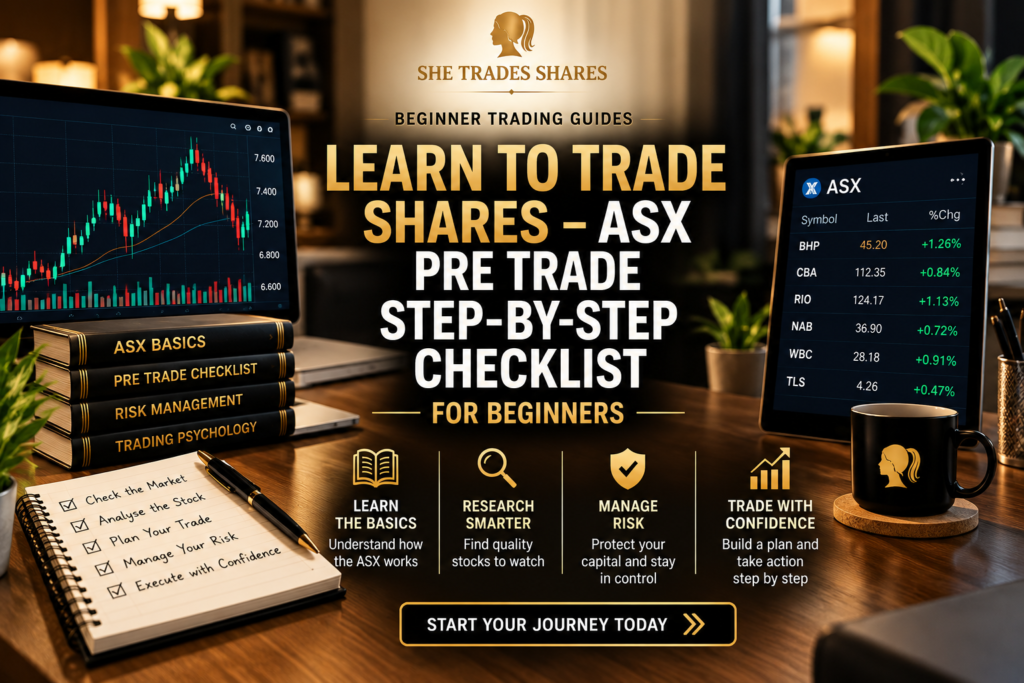
Learn To Trade Shares – The Foundation Every Beginner Needs
Learn to trade shares by starting with structure rather than speed. Most beginners do not struggle because they lack motivation; they struggle because individual trading topics are often presented without showing how those topics fit together. One video teaches indicators, another explains candlesticks and a forum recommends a strategy, but the beginner is left trying to decide what should come first. Before long, more information creates more confusion instead of more understanding.
She Trades Shares was deliberately designed from the perspective of a complete beginner. Nothing is skipped, nothing is assumed, and each concept is introduced when it has a clear place in the wider learning journey. Instead of trying to piece trading together from disconnected information, the learner builds a foundation progressively so later lessons have something to connect to. The objective is confidence through understanding, not confidence based on a tip, prediction or shortcut.
This page focuses on one important part of that foundation: understanding why preparation and a repeatable pre-trade routine matter before real money is put at risk. It will also show you where paper trading belongs and why practice should come before live execution. The purpose is not to give you the complete She Trades Shares trading process on one webpage. It is to help you understand what good preparation is building towards and where that lesson fits within the complete beginner journey.
Not sure what to learn next? The complete beginner roadmap shows you how the major stages of learning connect and where this lesson belongs.
Continue With The Complete Beginner RoadmapLearn To Trade Shares – Why A Pre-Trade Routine Matters
A trading decision begins before the Buy button is pressed. Preparation gives you time to consider what you are looking at, whether the situation fits the process you are learning and what risk may be involved before financial pressure enters the decision. Without that preparation, beginners can easily react to price movement, excitement or fear rather than following a considered process. A repeatable routine creates a pause between seeing an opportunity and acting on it.
A pre-trade routine can involve reviewing the broader market context, considering important areas on the chart, checking whether sufficient confirmation exists, thinking about risk and recording the reasoning behind a possible decision. These are not stand-alone instructions for entering a trade, and simply ticking boxes does not create a trading system. Each area needs to be understood within the wider framework so you know why you are checking it rather than mechanically following a list. That deeper application belongs inside the structured education and practice process.
Learn To Trade Shares – A Beginner Pre-Trade Preparation Check
- Have I reviewed the broader market context?
- Do I understand the important areas I am observing on the chart?
- Am I following the process I have been learning rather than reacting emotionally?
- Have I considered the risk before considering execution?
- Can I explain and record the reasoning behind the decision?
The value of a checklist is not the checklist itself; it is the thinking that should happen before each item can be answered. As your education develops, those questions gain more meaning because you begin to understand the concepts behind them and how they connect. Repeating a considered preparation process can also make it easier to review your decisions later and identify where your understanding still needs work. Structure comes first, and confidence develops as that structure begins to make sense.
Learn To Trade Shares – Practise Before You Risk Real Money
One mistake beginners can make is moving from learning directly into real-money trading before they have had an opportunity to practise their process. Paper trading provides a simulated environment where chart reading, preparation and decision-making can be practised without immediately placing real capital at risk. It does not remove the need for education, and simulated results should not be treated as proof of future live-trading results. Its value is that it gives you somewhere to apply what you are learning and discover where your understanding is still incomplete.
TradingView is the primary charting and paper-trading environment used throughout She Trades Shares education. It provides a consistent place to study charts and practise simulated decisions while you are developing your understanding. The platform itself does not tell you what constitutes a good trade or replace the judgement needed to manage risk. Think of it as the practice environment: the education provides the reason behind what you are practising.
Visit TradingView And Explore The Platform
Affiliate disclosure: This TradingView link is an affiliate link. She Trades Shares may receive a commission if you use it, at no additional cost to you. The affiliate relationship does not replace your own assessment of whether the service is appropriate for you.
Paper trading is most useful when it has a purpose. Rather than clicking Buy and Sell simply to see whether a simulated position makes money, use practice to become familiar with following a process, recording decisions and reviewing what happened. Practice helps turn information into experience, while review helps you identify what still needs to be understood. When you are ready for that stage, the beginner TradingView lesson shows you where paper trading fits into the wider learning journey.
Ready to practise without immediately risking real money? Continue to the beginner TradingView and paper-trading lesson.
Learn How Paper Trading Fits Into Your PracticeLearn To Trade Shares – Continue The Journey In The Right Order
Learning to trade shares becomes easier to understand when each subject builds on knowledge that came before it. Random lessons can introduce useful information, but they can also leave important gaps because the learner does not know which concepts are foundations and which belong later. The She Trades Shares Learn To Trade Roadmap was created to make that progression visible, so beginners can see where they are and what comes next. You do not need to learn everything at once; you need a clear sequence that allows understanding to build progressively.
That learning sequence begins with the transferable foundations rather than a specialised market or complicated strategy. Chart reading, market structure, risk, psychology, planning and practice need context before they can work together as a decision-making process. Once the foundation is established, later education can apply it to particular markets and instruments without starting from zero each time. This is the reason She Trades Shares teaches the foundation before specialisation.
The She Trades Shares Learning Architecture
Learn To Trade Shares – Series 1, The Foundation Of The She Trades Shares Learning Journey
Trading For Beginners: Learn To Read Charts, Manage Risk And Build Confidence Step By Step develops the transferable beginner foundation. Later She Trades Shares education can then apply that foundation to particular markets and instruments, with Futures Trading For Beginners — Series 2 being the first specialised application. A complete beginner starts by building the foundation rather than trying to specialise before the underlying concepts make sense.
Want to see how the complete beginner journey connects? Follow the roadmap and continue from the foundation forward.
Continue With The Complete Beginner RoadmapLearn To Trade Shares – Final Thoughts
Learning to trade shares is not about finding shortcuts or racing towards the first live trade. It is about building enough understanding to recognise what you are looking at, why a decision is being considered and where risk belongs before execution. Preparation, practice and review are parts of that development, but they become useful only when the concepts behind them are understood. The goal is not simply to follow rules; it is to gradually understand the reasoning that gives those rules a purpose.
Free videos, AI tools, articles and trading platforms can all support your learning, but they do not automatically organise that learning for you. Trading For Beginners — Series 1 provides the structured foundation that connects the major beginner concepts in the order they are intended to be learned. The public website helps you understand what matters and why; the course develops the complete education and application in depth. That keeps the learning journey clear: understand the foundation, practise with purpose and build towards more independent decision-making.
Learn To Trade Shares Series 1 — The Foundation
Ready To See What Is Inside The Complete Beginner Foundation?
See the complete Series 1 curriculum, what is included and how the structured beginner framework is organised before deciding whether it is the right learning path for you.
See What You Get Inside Trading For Beginners — Series 1Educational disclaimer: This page provides general educational information only and does not contain personal financial advice or a recommendation to buy, sell or trade any financial product. Trading and investing involve risk, including the risk of financial loss. Individuals are responsible for their own financial decisions and should consider their circumstances and obtain appropriate professional advice where required.
Learn to Trade Shares – Ultimate Resources Hub – 🔗
If you want to learn to trade shares without jumping between random tips, tools, and opinions, continue through the She Trades Shares Beginner Resource Hub. It brings the free lessons, practical walkthroughs, paper trading guides, chart-reading resources, and ASX masterclasses together in one structured learning order.The Hub is designed to help complete beginners understand where to start, what to learn next, and why each stage matters. Rather than trying to learn to trade shares by piecing unrelated information together, you can follow one connected pathway that builds your knowledge step by step.Nothing is skipped and nothing is assumed. Whether you are learning how to prepare a trade, practise with TradingView, understand market structure, or manage risk, each resource helps you continue learning to trade shares with greater clarity and confidence.