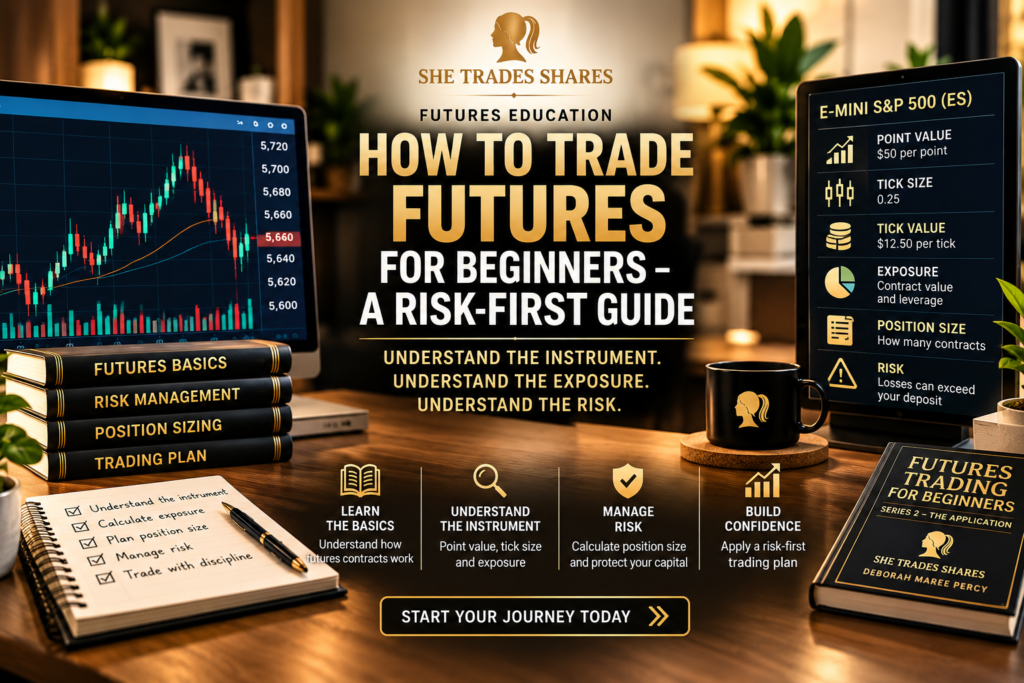
SHE TRADES SHARES — FUTURES EDUCATION
How To Trade Futures For Beginners – A Risk-First Guide
Understand The Instrument. Understand The Exposure. Understand The Risk.
Learning how to trade futures for beginners should not start with finding a fast entry, copying a setup or trying to predict where price will move next. It should start with understanding what a futures contract is, how leverage changes exposure and why risk needs to be considered before execution. Futures add instrument-specific mechanics to the trading process, but they do not remove the need for market structure, risk management and disciplined decision-making. The objective of this page is to show you where those pieces fit before execution becomes the focus.
Futures Are An Instrument — Not A Shortcut Around The Foundations
Before learning futures-specific mechanics, you need to be able to read price, recognise market structure, understand risk and follow a disciplined decision-making process. Those foundations provide the context needed to understand what is happening on a futures chart rather than simply reacting to price movement. Futures then add another layer: the contract, leverage, exposure and position sizing. That is why the learning order matters.
How To Trade Futures For Beginners – What Are Futures?
A futures contract is a standardised agreement linked to an underlying market, with contract specifications that determine how price movement translates into financial exposure. Futures markets can provide exposure to areas such as stock market indices, commodities, currencies and other financial markets. Unlike simply looking at the price of a share, a futures trader also needs to understand the contract itself. That means learning concepts such as contract size, points, ticks, multipliers, margin and leverage before deciding how much financial risk is involved in a trade.Understanding the contract itself is therefore one of the first steps when learning how to trade futures for beginners
Instrument → Exposure → Risk → Structure → Preparation → Execution → Discipline → Review
How To Trade Futures For Beginners – Understand The Contract First
One of the first differences a beginner needs to understand is that futures contracts have defined specifications. The movement you see on a chart needs to be connected to the contract you are actually trading. A point, tick and contract multiplier are not simply trading terminology to memorise. They help determine what market movement means financially, which is why understanding the instrument comes before choosing a position size or placing a trade. For anyone learning how to trade futures for beginners, understanding the instrument must come before deciding how much capital to expose.
Margin Is Not The Same Thing As Risk
The amount required to open or maintain a futures position does not by itself tell you how much money you could lose, so planned trade risk needs to be calculated separately. Margin, market exposure and planned risk describe different parts of the trade. Understanding those differences is essential when working with leveraged markets. Position size should therefore be determined through a risk process rather than simply by the amount of margin available.
Why Leverage Changes Futures Trading Risk
Futures are leveraged instruments, which means a trader can control market exposure that is larger than the amount of capital committed as margin. That leverage can magnify gains, but it can also magnify losses. This is why learning futures through speed, excitement or entry signals can leave a major gap in a beginner’s understanding. Before execution comes understanding, before position size comes exposure, and before strategy comes structure.This is why learning how to trade futures for beginners requires a clear understanding of leverage, exposure and planned risk before execution.
How To Trade Futures For Beginners – Market Structure Still Matters
Moving from shares into futures does not mean the principles of chart reading suddenly disappear. Price can still trend, correct, consolidate, form swings and react around important areas. The market-structure skills learned during foundational trading education continue to provide context. What changes is the instrument underneath the chart and the financial exposure attached to its movement.
This distinction matters because a familiar-looking chart can create false confidence. Understanding price behaviour is only one part of the futures decision. A futures trader also needs to know the contract, the financial value of movement, the exposure being accepted and the amount of planned risk before execution becomes appropriate. Learning how to trade futures for beginners therefore means connecting familiar market-structure principles with the specific mechanics and financial exposure of a futures contract.
Understand the structure. Wait for confirmation. Manage the risk. Execute the plan.
A futures workflow gives each decision a place in the process. Instead of beginning with an entry and trying to work backwards, the trader begins by understanding the instrument and exposure, then considers risk and market structure before preparing for execution. The purpose is not to make trading mechanical or remove uncertainty. It is to reduce avoidable decisions made without enough information.A structured process is especially important when learning how to trade futures for beginners because each decision should have a clear place before execution.
A Risk-First Futures Workflow
- Understand the instrument. Know what contract you are analysing and how it behaves.
- Understand the exposure. Connect points, ticks and contract specifications to financial value.
- Define the risk. Know what is financially at risk before execution.
- Read the structure. Assess market context before focusing on an entry.
- Prepare the trade. Define the conditions required before taking action.
- Execute the plan. Follow the process rather than reacting emotionally to price.
- Review the outcome. Study both the decision-making process and the result.
Before You Learn Futures – Check Your Trading Foundation
Futures Trading For Beginners — Series 2 is not designed to replace foundational trading education. It assumes you already understand concepts such as chart reading, trends, swing behaviour, support and resistance, top-down analysis, basic risk management and disciplined decision-making. If those concepts still feel unfamiliar, your next step is not to rush into futures mechanics; it is to build the foundation first. Series 1 or equivalent foundational study provides the knowledge that Series 2 then applies specifically to leveraged futures markets.
Do The Foundations Still Feel Unclear?
If chart reading, market structure, technical analysis, risk management and the trading process are still new to you, build that foundation before specialising in futures. Trading For Beginners — Series 1 is the foundation of the She Trades Shares learning journey.
Start With The Beginner Trading RoadmapAlready Have The Foundation? Now Apply It To Futures
Once the trading foundation is understood, futures education can become instrument-specific. Futures Trading For Beginners — Series 2 applies market structure, risk management and disciplined decision-making to leveraged futures markets while adding the contract mechanics, exposure calculations, position sizing and execution knowledge that futures require. You are not starting your trading education again; you are learning how an existing foundation applies to a different financial instrument.This is the point where learning how to trade futures for beginners moves from general trading foundations into futures-specific application.
Futures Trading For Beginners — A Risk-First Workflow For Leveraged Markets
Series 2 shows how to apply market structure, risk management and position sizing specifically to futures trading. The learning process moves from understanding the instrument and financial exposure through preparation, execution, discipline and review.
Explore Futures Trading For Beginners — Series 2Structure Before Strategy. Risk Before Execution.
Learning futures is not about finding the fastest route to a trade. It is about understanding what you are trading, what the movement means financially, where the risk sits and whether the decision fits a structured process. Build the foundation first. Then apply it to the instrument.
Ready To Go Straight To Futures Trading For Beginners — Series 2?
If you already have the trading foundation and you are ready to apply those skills specifically to futures, you can go directly to Futures Trading For Beginners — Series 2.
Take Me Straight To Futures Trading For Beginners — Series 2How To Trade Futures For Beginners – Important Note
Educational purposes only. This page provides general educational information and does not constitute personal financial advice or a recommendation to buy or sell any financial product. Futures trading involves significant risk and may not be suitable for all individuals. You are responsible for your own financial decisions.
She Trades Shares — Where Knowledge Builds Confidence.