Online Trading – Masterclass Series 3 – QBE (ASX) Technical Analysis & Market Structure

Online Trading – Chart Structure Step-by-Step Analysis
This online trading masterclass shows how professional chart structure is built using the ASX stock QBE as a real market example. What you are about to see is the finished result of a disciplined process built on structure, proportion, and market behaviour. This is not a trading signal page and it is not a prediction page. It is a real demonstration of how serious chart preparation looks before execution is ever considered.
Most people are shown charts the wrong way. They are taught entries before structure, indicators before context, and opinions before process. That is why so many beginners feel confused. This page is designed to reverse that. Instead of guessing, you will see how a blank chart becomes a structured decision framework layer by layer.
You do not need to understand every line yet. The purpose of this masterclass is to let you see the difference between random charting and professional preparation. Once you understand structure, the same framework can be applied across shares, Exchange Traded Funds (ETFs), futures, indices, and crypto markets. The instrument may change. Structure does not.
Understanding The Type Of ASX Stock You Are Looking At
QBE (ASX) is considered a defensive insurance and dividend-focused ASX financial stock. Unlike high-growth momentum companies, defensive financial stocks often produce slower but more stable market behaviour due to recurring cash flow, insurance premiums, and established business operations.This creates a very different chart structure compared to high-volatility growth stocks such as ZIP or cyclical resource stocks such as PLS.
Understanding the type of stock being analysed is an important part of professional market preparation because different sectors often produce different volatility, trend behaviour, dividend characteristics, and risk profiles.ASX insurance stocks are often influenced by claims cycles, premium growth, catastrophe risk, interest rates, and broader financial market conditions. This is why both technical analysis and fundamental analysis matter when analysing companies like QBE.
Online Trading – Why QBE Was Selected
QBE was selected because it represents a very different type of ASX market structure compared to high-growth momentum stocks. As a large international insurance and financial services company, QBE allows traders to study how defensive ASX shares behave during long-term market cycles.Unlike speculative resource stocks or aggressive growth companies, QBE often produces cleaner structural behaviour, slower trend development, stronger institutional participation, and more stable support and resistance zones. This makes it an ideal educational example for learning how professional chart structure develops over time.
QBE also demonstrates how defensive dividend-focused ASX stocks can still experience major trend phases, corrections, recovery structures, and breakout behaviour while maintaining broader long-term stability. This helps traders understand that different sectors produce different personalities, volatility profiles, and structural rhythms. Each chart in this masterclass builds directly on the one before it. Nothing random. Nothing decorative. Every level must earn its place. If you have ever looked at a chart and thought, I do not know where to begin, this page is designed to change that. You are about to see how a blank chart becomes a mapped decision framework using structure, proportional measurement, behavioural confirmation, and market context. Once you begin understanding the process properly, charts stop feeling chaotic. They start becoming readable.Start with the first chart below. Then follow each layer as new information is added and the market picture becomes clearer.
Online Trading-Monthly Chart 1-QBE
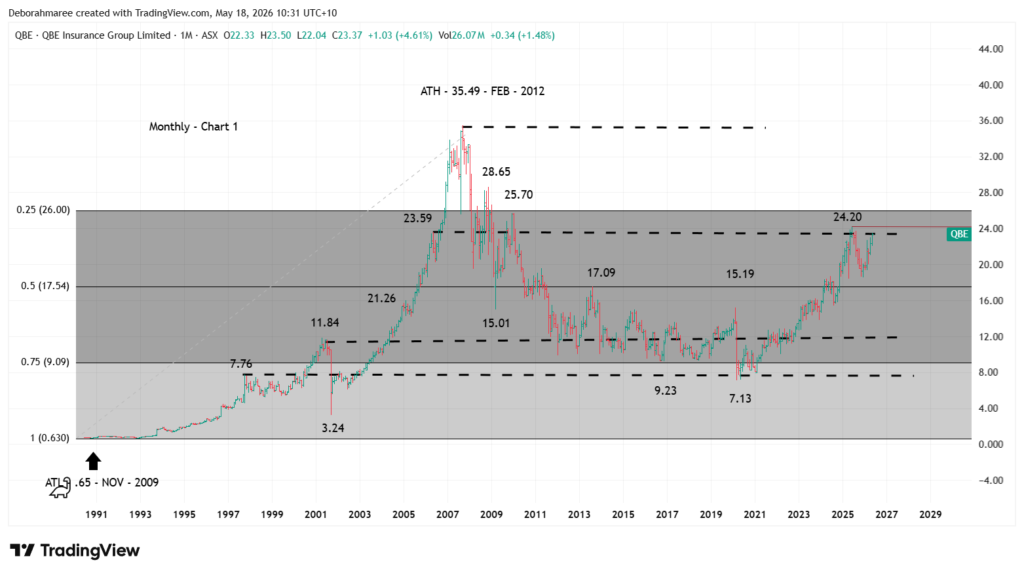
Online Trading – Chart 1 – QBE Monthly Chart Structure
Take a moment to study this first chart carefully.
This is the monthly QBE chart and it shows the first structural layer of the analysis. On this chart we have marked the all-time low at $0.65 in November 2009 and the all-time high at $35.49 in February 2012. Between those 2 extremes, the major proportional retracement levels at 25%, 50%, 75%, and the full range low have been mapped. These levels create the higher-timeframe framework of the full market cycle and define the range we are analysing.
We have also marked the major support and resistance levels already proven by price. Key structural zones can be seen around $7.13, $7.76, $9.23, $11.84, $15.01, $15.19, $17.09, $21.26, $23.59, $24.20, $25.70, and $28.65. These are areas where the market has previously reacted, stalled, accelerated, or reversed. That makes them important reference points for the next layers of analysis.
One of the most important areas on this chart is the current price region near the old $23.59 structural high. This level acted as a major historical resistance area before QBE eventually pushed into its 2012 all-time high. Price has now returned to this same region, with the recent structure pressing back toward the $24.20 area. That means QBE is now testing whether an old resistance zone can begin behaving as a new support region.
At this stage, the purpose is not to predict the next move and it is not to teach the full chart-building process. The purpose of this masterclass is to show you what a professionally prepared chart looks like once the structural work has already been completed. We are showing you the finished analysis, not the full method behind it.
Chart 1 matters because everything added later must sit inside this framework. If the higher-timeframe structure is wrong, every lower layer becomes weaker. This chart is the structural spine of the entire QBE market cycle.
The next chart builds directly on this foundation and shows how additional layers begin aligning with the framework you see here. If you want to learn how this process is actually done step by step, that is what the She Trades Shares Trading For Beginners E-Book is designed to teach.
Want To See What’s Inside The Trading For Beginners Course Before You Buy?
See What You Get Inside The E-Book For $49Online Trading-Monthly Chart 2-QBE
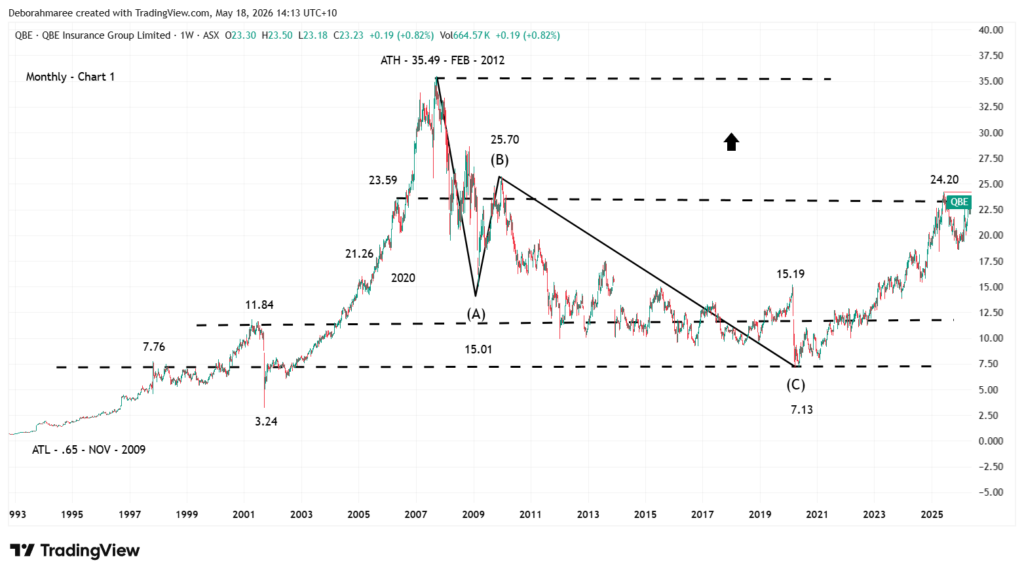
Online Trading – Chart 2 – Monthly QBE Support, Resistance and Corrective Wave Structure
Chart 2 builds directly on the structural framework introduced in Chart 1.
In the previous chart, we identified the all-time low at $0.65, the all-time high at $35.49, the major retracement zones, and the key support and resistance levels already proven by historical price behaviour. That gave us the higher-timeframe framework. This chart now adds behavioural structure and corrective wave progression.
The black wave structure mapped on this chart represents a possible long-term ABC corrective sequence developing from the 2012 all-time high. At this stage, this is not being treated as a confirmed completed Elliott Wave count. It is a structural interpretation based on proportional behaviour, overlapping movement, and the way the market has responded around key historical levels.
The first major decline from the all-time high at $35.49 into the $15.01 region is labelled as Wave A. From there, QBE produced a large corrective recovery rally into the $28.65 region, which is being interpreted as a possible Wave B recovery phase. The final decline from $28.65 into the major low at $7.13 is then mapped as the potential completion of Wave C.
One of the reasons this interpretation is important is because the overall decline from $35.49 to $7.13 does not currently behave as a clean impulsive five-wave bearish structure. The market shows significant overlapping behaviour, extended sideways movement, and corrective characteristics throughout the decline. Structurally, the broader ABC interpretation currently appears more proportional and internally consistent than a completed bearish five-wave collapse.
This does not mean the correction is guaranteed to be complete. It means the behaviour from the $7.13 low onward now becomes extremely important.
From the $7.13 low, QBE has produced a substantial recovery rally back into the $24.20 region. This places current price approximately within the deeper retracement region of the entire decline from the all-time high. Structurally, that creates an important decision zone.
The $24.20 level now becomes the immediate structural ceiling being tested by price. Above that, the next major historical resistance cluster sits around $25.70, followed by the larger structural pivot near $28.65. These zones matter because they represent prior areas where the market previously failed, reversed, or accelerated lower. If price can eventually accept above those regions, the larger bullish rebuilding scenario becomes structurally stronger. If rejection begins occurring at those levels, the possibility of the current rally behaving as a larger corrective recovery still remains open.
This is why professional chart analysis is never about certainty. It is about identifying the most structurally logical possibilities and allowing future price behaviour to confirm which pathway the market is actually choosing.
At this monthly stage, the chart provides structural possibility only. It does not provide execution detail. The next layer of analysis requires dropping into the weekly timeframe to examine the internal behaviour developing from the $7.13 low. That is where we begin testing whether the current recovery is behaving more like the early stages of a new impulsive advance, or whether it still carries corrective characteristics internally.
Chart 2 is therefore not about prediction. It is about structural interpretation and behavioural mapping. We are identifying the important historical zones, the possible corrective sequence, and the areas where future market behaviour becomes critical.
The next chart will now move into the weekly timeframe to begin examining the internal structure developing inside this recovery phase.
Want To See How Professional Traders Build Structure Step By Step?
Start Learning Trading The Right WayOnline Trading-Weekly Chart 3-QBE
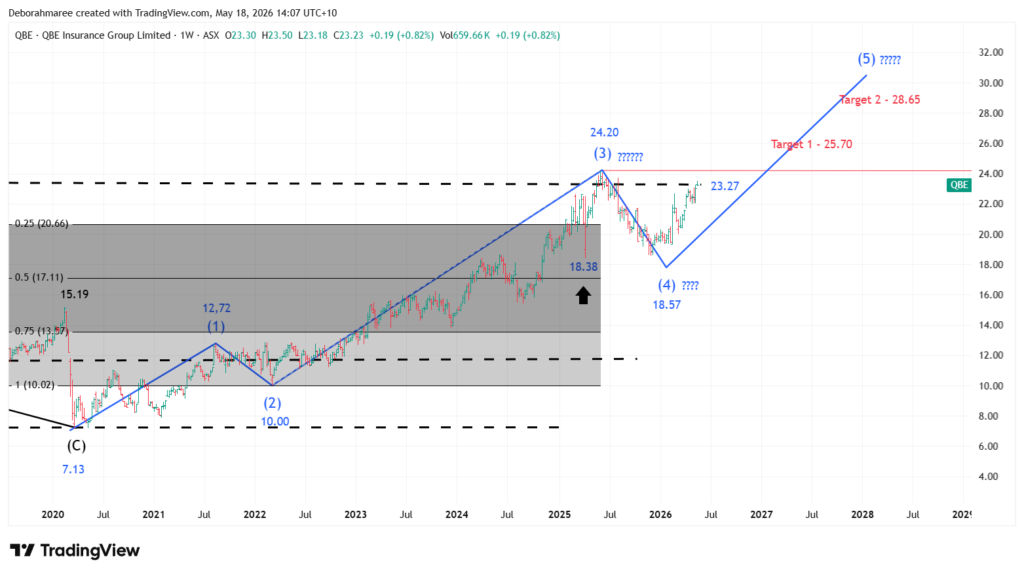
Online Trading – Weekly Chart 3 – QBE Internal Wave Structure
This chart now shifts from the higher-timeframe monthly structure into the internal weekly structure developing inside the broader QBE framework.
The blue wave count has been used intentionally to separate the weekly structure from the larger primary structure shown previously in black on the monthly charts. This allows us to study the internal behaviour of price movement without confusing it with the broader long-term market cycle.
At this stage, the weekly structure currently shows a possible developing impulsive sequence beginning from the major $7.13 low. The current working structure identifies a potential Wave 1 at $12.72, a possible Wave 2 retracement into $10.00, a strong advance into the potential Wave 3 region at $24.20, and a developing corrective area currently being monitored near the $18.38 to $18.57 region.
One of the most important areas on this chart is the black arrow marked at $18.38. This level represents the final meaningful swing low before the market pushed higher into the current $24.20 resistance zone. The reason this matters is because the market has not yet broken below that level. As a result, we cannot currently confirm that a completed Wave 4 correction has fully developed.
At this stage, there are still 2 realistic structural possibilities being monitored.
The first possibility is that the move into $24.20 completed a developing Wave 3 structure and the market is currently building a larger Wave 4 correction before potentially attempting another advance higher.
The second possibility is that the move into $24.20 may still be part of an extending Wave 3 structure that has not yet fully completed. This possibility remains valid because the market has not yet confirmed a lower structural sequence beneath the $18.38 region.
Because of this uncertainty, the current wave labels remain intentionally conservative. The structure is being monitored rather than forced into a fixed prediction. This is important because professional chart analysis must evolve with price behaviour rather than attempting to predict future movement with certainty.
The current resistance region near $24.20 remains one of the key structural decision zones on the chart. If price can eventually establish acceptance above this level, the next major confluence resistance zones begin appearing near $25.70 and then again near $28.65. These zones are not random projections. They are derived from previous higher-timeframe support and resistance behaviour already identified on the monthly charts.
At the same time, the $18.38 region remains structurally important because it currently acts as the final significant swing low inside the developing weekly structure. Until the market clearly breaks either above resistance or below support, both continuation and corrective scenarios remain possible.
This chart demonstrates one of the most important concepts in structural analysis. Markets do not always reveal their final wave structure immediately. Sometimes the correct approach is not prediction. Sometimes the correct approach is disciplined observation while the market continues building evidence.
The next stage of analysis would involve moving down into lower-timeframe structure to study whether internal behaviour begins supporting continuation or deeper correction. However, at this stage, the weekly chart already provides a strong structural framework for monitoring the current QBE market cycle.
Want To See How Professional Traders Build Structure Like This? Stop Piecing Trading Together Alone.
Start Learning Trading The Right WayUpdated 19/05/26 – Fundamental Overview – QBE Insurance Group
Alongside the technical structure already analysed in the previous charts, QBE also presents as a fundamentally stable business operating inside the global insurance sector.At the time of this analysis, QBE is producing strong earnings, maintaining healthy profit margins, and continuing to generate solid cash flow. The company also operates with relatively low weekly volatility compared to many higher-risk ASX growth stocks.Unlike speculative momentum stocks, QBE currently behaves more like a mature institutional-quality business focused on stability, operational performance, and long-term capital management.
Valuation, Earnings and Business Quality
One of the most interesting aspects of QBE’s current position is the disconnect between its valuation and its operational performance. QBE is currently trading on a relatively conservative PE ratio compared to several major insurance peers, despite producing strong earnings growth and maintaining a solid balance sheet profile. The company also continues paying dividends while generating healthy cash flow support behind its earnings. At the same time, future growth expectations remain more moderate than many high-growth sectors. This means the market currently views QBE more as a defensive value-style company rather than an aggressive expansion stock.
Want To Explore QBE’s Financials In More Detail?
View QBE On Simply Wall StFundamental Conclusion
From a fundamental perspective, QBE currently appears stronger as a stable long-term quality business than as a high-risk speculative growth stock. The combination of solid earnings, improving operational performance, conservative valuation metrics, and relatively stable price behaviour helps support the broader technical structure already identified throughout this masterclass.However, future growth expectations remain an important factor to monitor. Like all insurance businesses, QBE still remains exposed to changing market conditions, claims cycles, and broader economic risks. This is why both technical structure and fundamental behaviour must continue being monitored together rather than relying on a single form of analysis alone.Updated 10 October 2026 – QBE Market Structure and Fundamental Reassessment
When this Online Trading Masterclass was originally developed in May 2026, QBE Insurance Group was approaching an important historical resistance region near $24.20. Our original analysis identified several structural levels that could help explain how the market might respond as the recovery developed. The October 2026 price action now provides new evidence that allows us to revisit those observations and examine how the structure has evolved.
This update does not replace the original May analysis or suggest that subsequent market movements were guaranteed. Instead, it demonstrates how a prepared chart becomes a working reference framework that can be reviewed as new price information becomes available. This is a central principle of the She Trades Shares approach: structure must be understood before trading decisions are considered.
Revisiting the Original May 2026 Analysis
The original QBE monthly analysis identified historical resistance levels near $23.59, $24.20, $25.70 and $28.65. These levels represented areas where price had previously reacted, reversed or changed direction, making them useful references for understanding future market behaviour. They were never intended to represent guaranteed price targets or automatic trading signals.
By 9 October 2026, QBE had reached $25.15, placing the share price above the original $24.20 resistance reference and closer to the historical $25.70 region. This development suggests that the longer-term recovery has continued, but it does not establish that every nearby resistance level has been permanently overcome. The next stage is to examine whether the market can maintain its position above former resistance while responding to the next area of potential selling pressure.
This is where the value of the original structural preparation becomes clear. Rather than introducing completely new levels after the market has moved, we can return to the reference points already identified in May and examine how price has behaved around them. That comparison allows readers to see how historical support and resistance analysis remains useful as new market information develops.
Chart 4 – Updated QBE Monthly Structure – October 2026
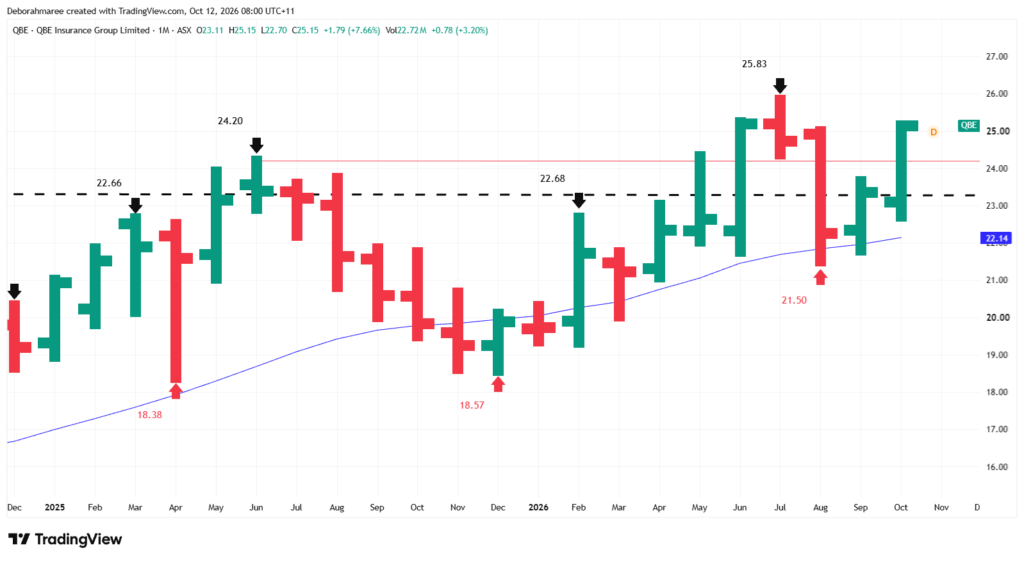
What the Updated Monthly QBE Chart Reveals
Chart 4 brings the original May 2026 analysis forward into October 2026, allowing us to examine how QBE’s market structure has developed over the intervening months. Rather than rebuilding the analysis from scratch, we are returning to the historical levels already identified and comparing them with the market’s subsequent behaviour. This is an important distinction because professional chart analysis should be reviewed against new evidence rather than adjusted simply to make earlier observations appear correct.
The monthly chart shows a sequence of important structural turning points, including the $18.38 low, the later $18.57 low and the more recent $21.50 low. These levels demonstrate that QBE has experienced meaningful corrective movements during its broader recovery rather than advancing in a straight line. The recovery from $21.50 is particularly relevant because it followed a retreat from the previous $25.83 high.
Understanding the Historical Resistance Levels
One of the most significant reference points in the original analysis was the $24.20 resistance area. The updated chart shows that QBE subsequently traded above this historical level and reached a higher reference point at $25.83 before experiencing another correction. This price behaviour illustrates why historical resistance should be treated as an area to monitor rather than an absolute barrier that price can never cross.
By 9 October 2026, the supplied TradingView chart showed QBE at $25.15, placing price above the original $24.20 reference and below the more recent $25.83 high. The earlier $25.70 historical resistance region therefore remains relevant, particularly because it sits close to the more recent monthly high. A move into this area would require further observation of price behaviour before any conclusion about sustained continuation could be drawn.
What the Moving Average Adds to the Structure
The blue moving average provides an additional visual reference for the broader direction of the monthly price movement. During the recent correction toward $21.50, price approached this rising reference before recovering into October. This helps illustrate how moving averages can be considered alongside historical price structure without replacing the importance of actual swing highs and swing lows.
A moving average does not guarantee that support will hold, nor does it independently confirm that a new advance must follow. Its educational value comes from showing the relationship between price and the broader trend over time. For that reason, the moving average is retained on the updated charts as supporting context rather than being treated as an automatic trading signal.
Why the Weekly Timeframe Matters Next
The monthly chart establishes the broader recovery and identifies the historical areas that remain important. However, individual monthly candles can contain several weeks of advances, corrections and changes in momentum that are not immediately visible at this scale. Moving to the weekly timeframe allows us to examine that internal behaviour while remaining connected to the higher-timeframe structure.
The purpose of the next chart is not to search for an immediate entry point or to predict QBE’s next movement. Instead, we will examine how the recovery from $21.50 developed, how price returned toward the previous highs and whether the weekly structure provides additional evidence about the broader trend. This continues the same disciplined process introduced in the original masterclass: structure first, interpretation second and risk before execution.
Chart 5 – Updated QBE Weekly Market Structure – October 2026
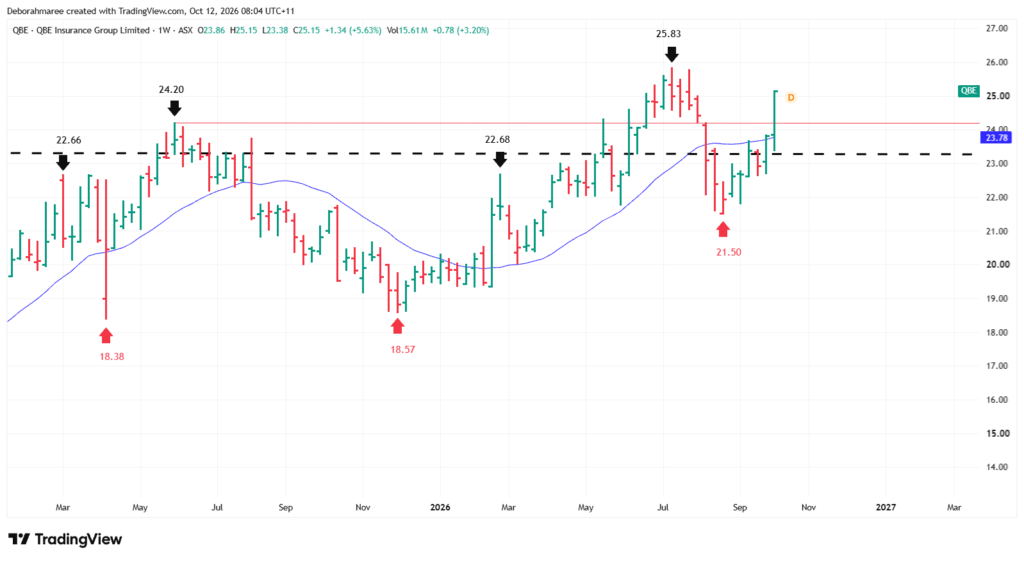
What Chart 5 Reveals About QBE’s Weekly Market Structure
Chart 5 takes the monthly structure examined in Chart 4 and brings it into the weekly timeframe, where the internal development of QBE’s recovery becomes easier to observe. The weekly chart provides a more detailed view of the advances, corrections and changes in price behaviour that occurred between the major monthly turning points. This additional perspective helps us evaluate whether the broader recovery is being supported by developing market structure rather than relying on the direction of the latest price movement alone.
The updated chart shows how QBE advanced from the $18.38 region into the previous $24.20 high before experiencing another meaningful corrective phase. A subsequent low near $18.57 was followed by a renewed advance, demonstrating that the market continued rebuilding after the earlier correction. These movements illustrate why the development of successive swing highs and swing lows remains central to understanding trend behaviour.
The $25.83 High and the Correction to $21.50
One of the most important developments since the original May analysis was QBE’s advance beyond the earlier $24.20 resistance reference and into the more recent $25.83 high. This demonstrated that price was capable of extending beyond the historical resistance area identified in the original masterclass. However, the subsequent correction toward $21.50 also demonstrated that a new high does not eliminate the possibility of a substantial retracement.
The $21.50 low is particularly important because it provides a more recent structural reference for evaluating the recovery that followed. Rather than interpreting the decline as proof that the broader trend had ended, the chart allows us to examine where selling pressure slowed and where buyers subsequently returned. The recovery toward $25.15 by 9 October 2026 shows that price had regained much of the ground lost during the correction, although the previous $25.83 high remained an important reference above the market.
Why the $23.59–$24.20 Region Still Matters
The original monthly analysis identified the $23.59–$24.20 area as an important historical resistance region. On the updated weekly chart, price has moved through this area on several occasions, showing that it is better understood as a structural zone than as a single exact price boundary. This distinction matters because historical resistance can be crossed, retested and temporarily lost without every movement producing a permanent change in the broader trend.
When price moves above a previous resistance region, traders can monitor whether subsequent corrections begin finding support around that same area. If price repeatedly fails to maintain the region, the strength of the developing advance may need to be reassessed. The purpose of observing this behaviour is not to assume that a particular outcome must occur, but to understand how the balance between buyers and sellers changes around previously important levels.
October 2026 – Reassessing the Original Elliott Wave Interpretation
In the original May 2026 masterclass, we examined a possible developing five-wave recovery from QBE’s major $7.13 low. The working weekly interpretation included a possible Wave 1 near $12.72, a Wave 2 correction toward $10.00 and a developing Wave 3 structure approaching the $24.20 region. At that time, the internal wave structure had not provided sufficient confirmation to establish a completed five-wave sequence.
The subsequent advance toward $25.83 provides additional evidence that the recovery continued beyond the original $24.20 reference. However, this does not automatically establish that the earlier Wave 3 interpretation was correct or that a completed Wave 4 correction has now occurred. Elliott Wave analysis requires the internal subdivisions, proportional relationships and relevant invalidation conditions to be examined before a revised count can be treated as a defensible working interpretation.
The correction from $25.83 toward $21.50 may be consistent with corrective behaviour inside a larger advancing structure, but the weekly chart alone does not establish its precise Elliott Wave classification. An alternative interpretation remains possible in which the broader recovery contains overlapping or extending corrective movements rather than a completed impulsive sequence. For this reason, the original wave labels should remain provisional until a fresh detailed count has been completed.
What Would Strengthen or Weaken the Recovery Interpretation?
A sustained move beyond the previous $25.83 high would provide further evidence that the recovery has continued into higher price territory. The historical $28.65 region would then remain a longer-term structural reference from the original monthly analysis, rather than a guaranteed destination. Even if price advances, the character of subsequent corrections would still need to be examined before drawing conclusions about the underlying wave sequence.
Conversely, renewed weakness through the $23.59–$24.20 region would require closer examination of the weekly recovery. The more recent $21.50 low provides another important structural reference because a sustained move beneath that area would weaken the immediate recovery interpretation. Neither outcome can be assumed in advance, which is why structural analysis must remain responsive to actual market behaviour.
October 2026 – QBE Fundamental and Valuation Update
Technical analysis provides a framework for understanding price behaviour, but it does not explain every influence affecting an insurance company’s financial performance. QBE operates in a sector where insurance premium growth, claims experience, catastrophe exposure, investment returns and operating expenses can materially affect profitability. These considerations remain relevant even when the share price is displaying a constructive recovery.
The October 2026 research information reviewed for this update indicated that QBE continued to expect gross written premium growth in the mid-single-digit range on a constant-currency basis. This provides a useful reference for understanding management’s business expectations, although premium growth does not automatically translate into equivalent profit growth. Claims costs, expenses and investment conditions can all influence the eventual financial outcome.
Understanding the Difference Between Price Targets and Fair Value
One of the research summaries supplied for this update referred to an analyst price target of approximately $27.50. A separate valuation narrative estimated QBE’s fair value at $18.26, following an increase from $17.89. These figures demonstrate that different analysts and valuation methods can produce substantially different estimates for the same company.
A price target represents an analyst’s assessment of where a share price might trade over a specified period, while an estimated fair value attempts to assess what the business may be worth under a particular set of assumptions. Neither figure is a confirmed future market price. They should also not be confused with the historical support and resistance levels identified through technical analysis.
The supplied valuation material also showed changes in the assumptions used to estimate QBE’s value, including lower assumed revenue growth, a slightly higher projected net profit margin and a modest increase in the assumed future price-to-earnings multiple. Changes of this kind can materially affect the resulting valuation even when the company’s underlying operations have not changed by the same amount. This is why valuation estimates should always be examined alongside the assumptions used to produce them.
Dividend Income and Insurance-Sector Risk
The supplied company information recorded an ordinary QBE dividend of $0.33 per share for the six months ended 30 June 2026, with a payment date of 2 October 2026. Dividend payments are an important consideration for investors evaluating mature financial businesses, but they should not be treated as guaranteed future income. Dividend amounts can change as earnings, capital requirements and business conditions evolve.
QBE also remains exposed to risks that are not always immediately apparent from a price chart. Major catastrophe events, unexpectedly high claims costs, changes in reinsurance conditions and rising technology expenses may all affect future profitability. A business can therefore maintain a constructive technical structure while still facing meaningful fundamental uncertainty.
What This QBE Update Teaches Us
The most important lesson from this update is not that QBE moved above an earlier resistance level. It is that the original chart provided a structured framework against which later market behaviour could be evaluated. The historical levels, subsequent corrections and new price highs all contribute evidence that can strengthen or challenge an earlier interpretation.
This is why She Trades Shares teaches structure before strategy and risk before execution. A chart is not valuable because it appears to predict the future. It becomes valuable when it helps traders identify relevant evidence, recognise uncertainty and prepare decisions through a repeatable educational process.
QBE October 2026 Update – Final Market Structure Conclusion
The updated monthly and weekly charts show that QBE’s recovery continued beyond the original $24.20 resistance reference identified in May 2026. Price subsequently reached $25.83, corrected toward $21.50 and recovered to $25.15 by 9 October 2026. These developments provide a practical example of how historical levels can remain relevant as a market progresses through new phases of movement.
The broader recovery remains an important feature of the chart, but its future direction is not certain. The nearby $25.70 and $25.83 regions remain relevant resistance references, while the $23.59–$24.20 area and the more recent $21.50 low provide important areas for monitoring corrective behaviour. These are structural observations rather than instructions to buy, sell or hold QBE shares.
Fundamentally, QBE continues to operate within an established global insurance business model, but future earnings and valuation remain exposed to changing business assumptions and sector-specific risks. The differing analyst price targets and fair-value estimates reinforce the importance of recognising uncertainty rather than relying on a single forecast. Combining technical structure with fundamental context produces a more complete educational assessment than either approach can provide alone.
The purpose of this October update is therefore to demonstrate disciplined reassessment, not retrospective prediction. Readers can compare the original May charts with the October monthly and weekly updates to see how market structure evolves over time. The central lesson remains unchanged: understand the structure, respect the risk and allow new evidence to guide the analysis.
Resources 🔗
This QBE masterclass is Series 3 of our 5-part Online Trading Masterclass collection, featuring ZIP (ASX), PLS (ASX), QBE (ASX), TLS (ASX) CGF(ASX)
Once you have completed this QBE masterclass, explore the other three masterclasses featuring ZIP (ASX), PLS (ASX),TLS (ASX), CGF(ASX) Each company provides a different example of how market structure develops across different sectors and market conditions. Comparing these charts will help you recognise how the same analytical principles can be applied to different shares. You can also explore additional educational tools, walkthroughs and learning resources inside the She Trades Shares Resource Hub.
Trading for Beginners Guide – The Ultimate Resource Hub
Masterclass Series
View Online Masterclass ZIP – Series 1 Here
View Online Masterclass PLS – Series 2 Here
View Online Masterclass TLS – Series 4 Here
View Online Masterclass CGF- Series 5 Here

Understand the market.
Trade QBE with confidence.
One Comment