Online Trading – Masterclass Series 4 – TLS (ASX) Technical Analysis & Market Structure

Online Trading – Chart Structure Step-by-Step Analysis
This online trading masterclass shows how professional chart structure is built using the ASX stock TLS as a real market example. What you are about to see is the finished result of a disciplined process built on structure, proportion, and market behaviour. This is not a trading signal page and it is not a prediction page. It is a real demonstration of how serious chart preparation looks before execution is ever considered.
Most people are shown charts the wrong way. They are taught entries before structure, indicators before context, and opinions before process. That is why so many beginners feel confused. This page is designed to reverse that. Instead of guessing, you will see how a blank chart becomes a structured decision framework layer by layer.
You do not need to understand every line yet. The purpose of this masterclass is to let you see the difference between random charting and professional preparation. Once you understand structure, the same framework can be applied across shares, Exchange Traded Funds (ETFs), futures, indices, and crypto markets. The instrument may change. Structure does not.
Understanding The Type Of ASX Stock You Are Looking At
TLS (ASX) is considered a defensive dividend-focused ASX telecommunications and infrastructure-style stock. Unlike high-volatility growth companies or cyclical resource stocks, defensive telecommunications businesses often produce slower but more stable long-term market behaviour due to recurring revenue, infrastructure ownership, customer retention, and essential service demand.
This creates a very different chart structure compared to high-growth momentum stocks such as ZIP or cyclical commodity-driven stocks such as PLS. Defensive dividend-focused companies often develop broader multi-year accumulation phases, slower trend progression, and stronger institutional participation.
Understanding the type of stock being analysed is an important part of professional market preparation because different sectors often produce different volatility, trend behaviour, dividend characteristics, and risk profiles.
ASX telecommunications stocks are often influenced by interest rates, infrastructure spending, population growth, competitive pricing pressure, government regulation, and broader economic conditions. This is why both technical analysis and fundamental analysis matter when analysing companies like TLS.
Online Trading – Why TLS Was Selected
TLS was selected because it represents a very different type of ASX market structure compared to high-growth momentum stocks and cyclical resource companies. As one of the largest telecommunications businesses on the ASX, TLS allows traders to study how long-term defensive dividend-focused stocks behave across multiple market cycles.
Unlike speculative growth companies, TLS often produces slower structural development, broader accumulation phases, long-term support building, and cleaner institutional behaviour. This makes it an ideal educational example for understanding how major defensive ASX stocks can rebuild structure over many years.
TLS also presents an interesting long-term structural case because the historical decline from the 1999 all-time high into the 2010 major low currently contains overlapping corrective behaviour rather than a completely clean impulsive collapse. This creates several possible structural interpretations that are still developing today.
One of the most important lessons inside this masterclass is understanding that professional chart analysis is not about forcing certainty onto the market. Sometimes multiple structural possibilities remain valid while the market continues building evidence over time.
Each chart in this masterclass builds directly on the one before it. Nothing random. Nothing decorative. Every level must earn its place. If you have ever looked at a chart and thought, I do not know where to begin, this page is designed to change that.
You are about to see how a blank chart becomes a mapped decision framework using structure, proportional measurement, behavioural confirmation, and market context. Once you begin understanding the process properly, charts stop feeling chaotic. They start becoming readable.
Start with the first chart below. Then follow each layer as new information is added and the market picture becomes clearer.
Online Trading-Monthly Chart 1-TLS
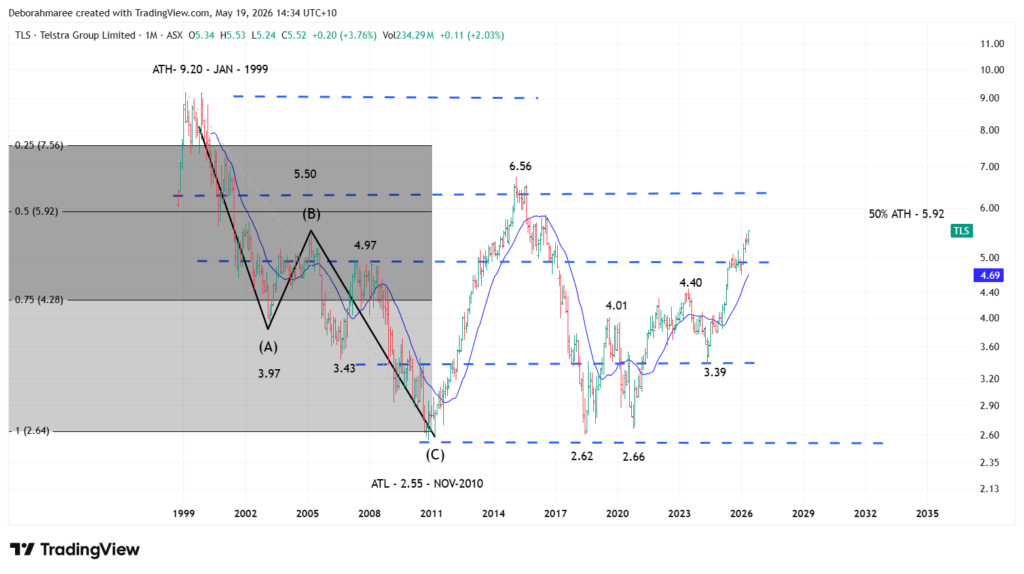
Online Trading – Chart 1 – TLS Monthly Chart Structure
Take a moment to study this first chart carefully.
This is the monthly TLS (Telstra Group) chart and it shows the first structural layer of the analysis. On this chart we have mapped the all-time high at $9.20 in January 1999 and the all-time low at $2.55 in November 2010. Between those 2 extremes, the major proportional retracement levels at 25%, 50%, 75%, and the full-range low have been measured and mapped across the chart structure.
The 25% retracement level currently sits near $7.56. The 50% retracement level sits near $5.92. The 75% retracement level sits near $4.28. The full-range low remains near $2.64. These levels are important because they create the higher-timeframe structural framework of the entire TLS market cycle.
We have also identified several major historical swing points already proven by market behaviour. Key structural pivots can be seen near $5.50, $4.97, $6.56, $4.01, $4.40, $3.39, $2.62, and $2.66. These are not random levels. They represent historical areas where the market previously reversed, accelerated, stalled, or rebuilt structure.
One of the most important areas on this chart is the long-term behaviour developing around the $2.62 to $2.66 region. Structurally, this area currently behaves similarly to a potential long-term double-bottom support region because both major lows formed within only a few cents of each other despite occurring years apart. This suggests strong historical price memory around that zone.
From that base region, TLS has now produced a significant recovery phase back toward the $5.50 to $5.92 region. This area matters because it sits directly beneath the larger 50% retracement region of the entire historical decline from the $9.20 all-time high into the $2.55 low.
At this stage, the structure can still be interpreted in multiple ways. The earlier decline from the $9.20 peak into the $2.55 low currently displays many corrective characteristics, including overlapping movement and irregular recovery phases. Structurally, this creates the possibility that the larger decline may represent a long-term ABC corrective structure rather than a completed impulsive five-wave collapse.
At the same time, the current recovery from the major lows may still be developing as part of a much larger rebuilding phase. The market has not yet provided enough confirmation to fully validate either interpretation. This is why professional chart analysis focuses on structural observation first rather than prediction.
At this stage, the purpose is not to predict the next move and it is not to teach the full chart-building process. The purpose of this masterclass is to show you what a professionally prepared chart looks like once the structural work has already been completed. We are showing you the finished analysis, not the full method behind it.
The purpose of this chart is to establish the higher-timeframe framework that every lower timeframe must operate inside. This chart becomes the structural spine of the entire TLS market cycle.
Chart 1 matters because every additional layer added later must align with the structure already established here. If the higher-timeframe framework is weak, the lower-timeframe analysis becomes unreliable.
The next chart will build directly on this foundation and begin examining the broader behavioural structure developing inside the TLS recovery phase. If you want to learn how this process is actually done step by step, that is what the She Trades Shares Trading For Beginners E-Book is designed to teach.
Want To See What’s Inside The Trading For Beginners Course Before You Buy?
See What You Get Inside The E-Book For $49Online Trading-Monthly Chart 2-TLS
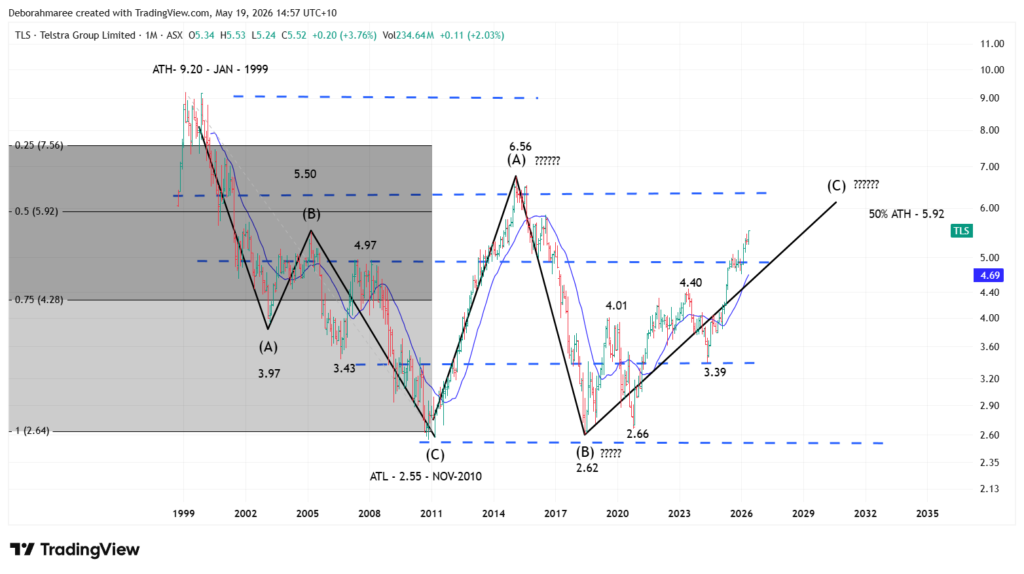
Online Trading – Chart 2 – TLS Monthly Corrective Structure and Behavioural Mapping
Chart 2 builds directly on the structural framework introduced in Chart 1.
In the previous chart, we identified the all-time high at $9.20, the all-time low at $2.55, the major proportional retracement zones, and the key historical support and resistance levels already proven by price behaviour. That established the higher-timeframe framework. This chart now adds possible behavioural structure and long-term corrective interpretation.
The black wave structure mapped across this chart represents one possible long-term ABC corrective sequence developing from the 1999 all-time high. At this stage, this is not being treated as a confirmed Elliott Wave count. It is a structural interpretation only based on proportional behaviour, overlapping movement, and the way TLS has historically reacted around major support and resistance zones.
The initial decline from the $9.20 all-time high into the first major low near $3.97 is currently being monitored as a possible Wave A structure. From there, TLS produced a significant recovery phase into the $5.50 region, which is being interpreted as a possible Wave B recovery rally. The broader decline that followed into the $2.55 all-time low in November 2010 is then being monitored as the potential completion of a much larger Wave C corrective sequence.
One of the reasons this interpretation matters is because the overall decline from $9.20 into $2.55 currently displays many overlapping corrective characteristics rather than behaving like a completely clean impulsive five-wave collapse. Throughout the decline, TLS produced multiple overlapping rallies, broad retracement behaviour, and slower corrective movement. Structurally, the broader ABC interpretation currently appears more proportional than a completed bearish impulse structure.
However, at this stage, the structure still remains open to multiple interpretations. The recovery phase developing from the 2010 lows may represent the early stages of an entirely new long-term market cycle, or it may still be part of a much larger corrective rebuilding structure. The market has not yet provided enough confirmation to fully validate either scenario.
One of the most important structural regions on this chart is the long-term support behaviour developing around the $2.62 to $2.66 region. The fact that TLS produced multiple major lows within only a few cents of each other across many years creates the appearance of a possible long-term double-bottom support base. This suggests strong historical price memory inside that zone.
From that broader support region, TLS has now recovered back toward the $5.50 to $5.92 area. This region matters because it sits directly beneath the larger 50% retracement level of the entire historical decline from the all-time high into the major low.
The current recovery also contains several important structural pivots already proven by price behaviour near $4.01, $4.40, and $5.50. These levels now become important reference points for determining whether TLS is continuing to build strength internally or whether broader corrective behaviour may still remain active.
At this stage, the purpose is not to predict the next move and it is not to force a fixed Elliott Wave count onto the market. The purpose of this chart is to map the most structurally logical possibilities based on the information currently available.
Professional chart analysis is not about certainty. It is about identifying proportional behaviour, historical reactions, structural relationships, and allowing future price behaviour to confirm which pathway the market is actually choosing.
This chart now provides the broader monthly behavioural framework. The next stage of analysis requires dropping into the weekly timeframe to begin studying the internal structure developing inside the TLS recovery phase. That is where we begin examining whether the current market behaviour supports continuation, correction, or a larger long-term rebuilding cycle.
If you want to learn how this process is actually built step by step, that is what the She Trades Shares Trading For Beginners E-Book is designed to teach.
Want To See How Professional Traders Build Structure Step By Step?
Start Learning Trading The Right WayOnline Trading-Weekly Chart 3-TLS
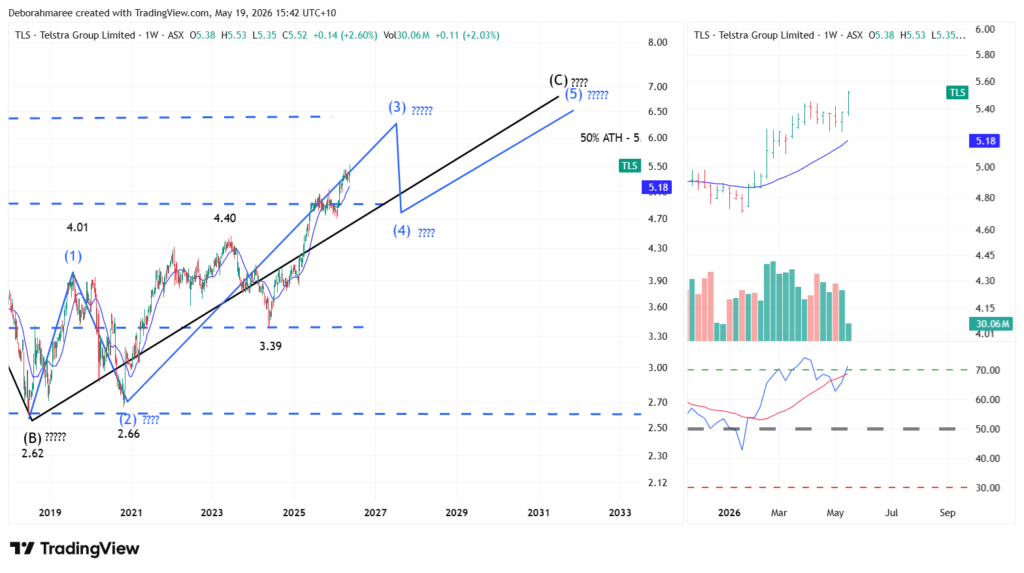
Online Trading – Weekly Chart 3– TLS Current Structural Behaviour
This chart now shifts from the broader monthly framework into the current weekly behaviour developing inside the larger TLS structure.
The purpose of this chart is to study the internal behaviour currently forming as TLS continues attempting to rebuild from the major historical lows near the $2.62 to $2.66 region previously identified on the monthly charts.
At this stage, the weekly structure currently shows a possible developing impulsive rebuilding sequence forming from the 2020–2022 recovery base. The blue wave count has been used to separate the internal weekly structure from the broader higher-timeframe corrective structure already discussed on the monthly charts.
The current working interpretation identifies a possible developing Wave 1 near $4.01, a corrective Wave 2 retest near $2.66, and a developing Wave 3 advance currently pushing back toward the larger resistance region surrounding the 50% retracement zone near $5.92.
One of the most important areas on this chart is the rising structural support trendline currently supporting the recovery phase. Multiple reactions have already respected this rising support region, which suggests the market is currently attempting to maintain constructive higher-low behaviour as price continues rebuilding upward.
The current resistance region between approximately $5.50 and $5.92 now becomes extremely important structurally because this area represents both historical market resistance and the larger 50% retracement region of the entire long-term decline from the $9.20 all-time high into the $2.55 low.
At this stage, there are still multiple possible structural interpretations being monitored.
The first possibility is that TLS may currently be developing a larger impulsive rebuilding structure where the current advance eventually evolves into a broader Wave 3 continuation phase. If this scenario continues developing constructively, future structural targets may eventually begin testing the larger resistance region near the posible Wave 5 and possible broader Wave C overlap zone.
The second possibility is that the current advance may still remain part of a larger corrective recovery structure developing inside the broader historical decline. This remains possible because the market has not yet fully confirmed a completed long-term trend reversal structure on the higher timeframes.
This is why professional chart analysis focuses on structural behaviour and confirmation rather than certainty or prediction.
The RSI panel currently shows momentum remaining relatively constructive on the weekly timeframe while volume behaviour continues supporting the broader recovery structure. However, momentum alone never confirms structure. Price behaviour around the major resistance region remains the most important factor being monitored.
At this stage, the purpose is not to predict the next move. The purpose is to study how the market behaves as it approaches major higher-timeframe structural resistance. This is where professional chart analysis becomes important because behaviour near key levels often reveals whether a market is strengthening, exhausting, rejecting, or rebuilding.
This chart represents the current live behavioural layer inside the larger TLS market cycle. Future updates may continue refining the structure as additional market behaviour develops.
If you want to learn how this type of structured analysis is built step by step, the She Trades Shares Trading For Beginners E-Book is designed to teach the full framework behind the process.
Ready To Build Real Trading Confidence?
Yes, Take Me Straight To The Sales Page.Updated 19/05/26 – Online Trading – Fundamental Overview – Telstra Group (TLS)
Alongside the technical structure already analysed throughout the previous charts, TLS also presents as a fundamentally mature telecommunications and infrastructure-style business operating inside the Australian telecom sector. At the time of this analysis, TLS continues producing stable earnings, strong operating cash flow, and consistent dividend distributions while maintaining relatively lower volatility compared to many higher-risk ASX growth stocks.Unlike speculative momentum companies, TLS currently behaves more like a mature institutional-quality business focused on infrastructure ownership, recurring revenue, operational stability, and long-term shareholder returns.
Online Trading – Valuation, Earnings and Business Quality
One of the most interesting aspects of TLS’s current position is the balance between defensive stability and moderate long-term growth expectations.TLS currently trades with a more conservative growth profile compared to many aggressive ASX growth stocks. Forecast earnings growth currently remains relatively modest near 4–5% annually, while revenue growth expectations remain lower than many high-expansion sectors. This aligns with the defensive and mature nature of the telecommunications industry.
At the same time, TLS continues generating strong cash flow support behind the business while maintaining healthy operational profitability and return on equity metrics. The company also continues returning capital to shareholders through dividends and buyback activity.TLS also remains a dividend-focused ASX stock, currently producing a dividend yield near 3.9% while continuing capital return initiatives through share buybacks. This helps explain why TLS often attracts long-term institutional and income-focused investors rather than short-term speculative momentum trading.
One of the key characteristics of mature telecommunications companies is that they often prioritise operational consistency, infrastructure investment, customer retention, and shareholder yield rather than aggressive expansion. This helps explain why TLS often produces slower but more stable long-term chart behaviour compared to high-volatility speculative stocks.TLS currently also remains influenced by broader economic conditions including interest rates, infrastructure spending, competitive pricing pressure, mobile network demand, and regulatory conditions across the telecommunications sector.
From a fundamental perspective, TLS currently appears stronger as a mature defensive income-style business than as a high-growth speculative expansion stock.The combination of stable earnings, recurring cash flow, infrastructure ownership, dividend support, and relatively lower volatility helps support the broader technical rebuilding structure already identified throughout this masterclass. However, future growth expectations remain more moderate compared to many aggressive ASX growth sectors. This means TLS may continue behaving as a slower-moving institutional-style stock rather than a high-volatility momentum stock.Like all telecommunications businesses, TLS still remains exposed to changing economic conditions, competitive pressure, infrastructure costs, interest rates, and regulatory risk. This is why both technical structure and fundamental behaviour must continue being monitored together rather than relying on a single form of analysis alone.
Want To Explore TLS Financials In More Detail?
View TLS On Simply Wall StOnline Trading – Resources 🔗
This is Series 4– 5 of a 4 part series Online Masterclass including ZIP(ASX), PLS(ASX), QBE(ASX), TLS(ASX), CGF(ASX)
Once you have finished analizing this post you can then move on to the next Series featuring PLS (ASX), ZIP(ASX) , QBE(ASX), CGF(ASX). Start here first, then click below to view the other masterclasses. You can then compare how the same structure applies to a different market. Once you’ve started learning the framework, you can explore additional tools, walkthroughs, and resources inside the She Trades Shares Hub
Trading for Beginners Guide – The Ultimate Resource Hub
Online Trading – Masterclass Series
View Online Masterclass ZIP – Series 1 Here
View Online Masterclass PLS – Series 2 Here
View Online Masterclass QBE – Series 3 Here
View Online Masterclass CGF – Series 5 Here

One Comment